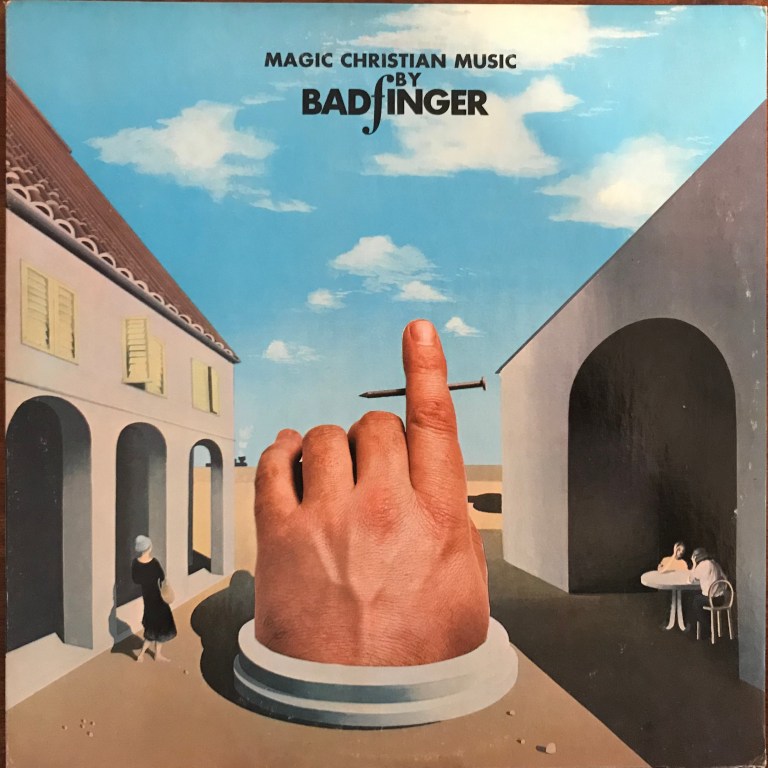
MAGIC CHRISTIAN MUSIC by Badfinger

It’s time for another installment of “David’s Records,” wherein I reach into my crates and pull out one of my Uncle’s records at random to revisit. This time I choose the 1970 album MAGIC CHRISTIAN MUSIC by Badfinger. If I’m honest, when I pulled this one out, I nearly stuck it back. But why would I do that? Do I hate Badfinger? Not at all. I quite like what little of Badfinger I’ve heard. The reason I dreaded writing a post on this record is all the Badfinger baggage. The music industry is notoriously a ravenous machine designed to chew artists up and spit them out jaded, addicted, and destitute. But what happened to Badfinger is on a whole other level of bad. I’m going to skip over all that stuff as I feel like most people who happen upon this will know the entire story. If you don’t, take an antidepressant and Google the band.

Badfinger famously began their career as The Iveys and had the honor of being the most successful band signed to Apple Records not named The Beatles. Being handpicked for success by The Beatles at the height of their fame only to fall as tragically as Badfinger did is the kind of story made for Hollywood. I seriously can’t believe we haven’t gotten a biopic about them. Oh, shoot…there I go getting sucked back into the sad tale of Badfinger.

MAGIC CHRISTIAN MUSIC is a bizarre title referencing a 1969 Peter Sellers film titled The Magic Christian. For years (decades actually), I always assumed that MAGIC CHRISTIAN MUSIC was that film’s soundtrack. The Magic Christian co-stars Ringo Starr and features three songs from MAGIC CHRISTIAN MUSIC. However, according to my extensive Google research, this record is not the official soundtrack. Apple was scheduled to release the official soundtrack, but the addition of one song prevented them from doing this (the music biz is hard), so MAGIC CHRISTIAN MUSIC was released instead. Paul McCartney produced the three tracks used in The Magic Christian, and he even wrote one.

The album opens with “Come and Get It,” the song Paul wrote and gave to the band. Paul wrote this song during the ABBEY ROAD sessions, and it sounds like that era McCartney. I think my first exposure to this song was hearing it in a commercial sometime during the 1990s. When the Beatles Anthology came out, it featured a rough mix of this song, and I was blown away by it. I couldn’t help but think, “why didn’t this song make it onto the album?” Well, it’s because Paul gave it to Badfinger because his record label had signed them, of course. All of the tracks on MAGIC CHRISTIAN MUSIC sound very Beatle-esque however, this one straight up sounds like The Beatles.

I like “Crimson Ship,” but I honestly cannot figure out what it’s about. There’s mention of crosses and resurrection in the lyrics, which makes me think there’s some Jesus stuff going on in the song, but I’ve never heard of anything in Christianity referred to as a crimson ship. I’m assuming if I were more religious and/or Welsh, I’d get the reference. The guitar hook is cool. The next song, “Dear Angie,” sounds like an earlier Beatles track John Lennon might have written for RUBBER SOUL. It’s very much a boy-loves-a-girl song, and the song ends on the punchline that the thing he’s got to tell her is, “I love you, you’re my all, that’s all.” While not as clever as a classic Beatles love song (seriously, they rhyme “all” with “all”), this is a decent track, and the vocals sound remarkably like Lennon in places.

The next song, “Fisherman,” is the first track on the album I had not heard before picking up this album. Unfortunately, it is not very good. It sort of drones on and seems to ape those Beatles songs that are spacey and weird but also about quaint English people. It feels very forced and is pretty dull. “Midnight Sun,” on the other hand, is an excellent breath of fresh air after such a monotonous track. The drums on this track sound fantastic. The 1970s were the zenith for drummers on record; you had guys like Keith Moon and John Bonham just absolutely killing it on the drums, and on “Midnight Sun,” Mike Gibbins is also banging his heart out. And I love it.

“Beautiful and Blue” is a decent attempt at a Lennon psych-rock. Sadly, the lyrics are pretty standard guess-the-rhyme fair that’s too predictable. It sounds nice but is rather hollow. “Rock of Ages” is another barnburner in the vein of “Midnight Sun,” although this track’s just a touch better because it’s the second track produced by McCartney. I think that this is probably my favorite track on the album. It’s not the catchiest and doesn’t have the best lyrics, but it’s a perfect evolution of British rock. I don’t think a mid-1970s Beatles album would have sounded like “Rock of Ages,” but when I imagine a 1977 Beatles record, this is what my brain conjures.

The next song, “Carry On Till Tomorrow,” is the third and final track produced by McCartney, and it’s absolutely gorgeous. Lyrically somber, the song’s structure is interesting with soaring vocals, strumming acoustic guitar complemented by a great electric solo. A sad song about keeping going in the face of heartbreak/adversity, this song is Badfingers “Let It Be.” And while this might be blasphemy, but I think I might like it slightly more than “Let It Be.” This achingly sad song is followed up with “I’m In Love,” a simple, goofy song about being in love that frankly sounds like a Monkees castoff. The rhymes are simple, and the sentiment is simple; it’s disposable bubblegum pop at its finest. The drums are once again killer (those crashing high hats!), but overall, the emotional whiplash induced by going from such a serious track to this pop fluff ultimately hurts the song and the album’s flow.

There’s more emotional whiplash when the album veers back into sad and moving with “Walk Out in the Rain,” which I appreciate for its stripped-down, honest feeling. That said, the screeching “be mineeee!” is over the top and kills the song’s mood. The call and response harmonies do a lot to salvage the song, but this one feels like a re-write or two away from being a great song. “Angelique” is a mid-tempo snoozer that feels like album filler and is a less exciting version of “Dear Angie.” One of the more interesting tracks on the album’s b-side, “Knocking Down Our Home,” sounds like a combination of McCartney’s WHITE ALBUM “Honey Pie” and VILLAGE GREEN-era Kinks. This song has the kind of variety MAGIC CHRISTIAN MUSIC desperately needed; it’s a shame the band didn’t try a few more tracks like this outside of rockers and ballads.

Speaking of rockers, the final big rockers on the album “Give it a Try” is a retread of “Midnight Sun” and “Rock of Ages.” It’s not a bad song, but it’s the weakest rocker on the album. The album closes with “Maybe Tomorrow,” which, like “Give it a Try,” is the weakest ballad on the album. Again, it’s not terrible, but on an album with “Carry on Till Tomorrow,” it feels lesser. Also, as a somewhat writer myself, it baffles me the band would choose to have two songs on the same record that are so similar that also feature the word “tomorrow” in their title. Of the two tomorrow ballads, “Maybe Tomorrow” is the more classically Beatles-esque.

As I put the record back in the sleeve, I couldn’t help but feel as if I’ve been a bit too hard on MAGIC CHRISTIAN MUSIC. Frankly, I think Badfinger’s association with The Beatles was more of a hindrance than a help. I believe having McCartney writing and producing and generally giving the band a leg up made folks (myself included) view the band with more of a critical eye. For a band’s second album, this is great, and all of these songs are way better than anything written by the countless other Beatles-inspired bands that came after them. Compare Badfinger’s second record to the second record Jet put out.

Listening to MAGIC CHRISTIAN MUSIC has piqued my curiosity for the band. Before listening to writing this post, my only exposure to Badfinger was a Greatest Hits compilation I own. However, MAGIC CHRISTIAN MUSIC has enough interesting things going on in the non-single tracks to convince me I need to sit down and go through the band’s entire discography. The good news is that thanks to my Uncle, I have all the band’s other releases. So this is not the last we’ll hear from Badfinger here in the Record Dungeon.

THE RAMBLIN’ MAN by Waylon Jennings

Well, I did it again. I reached into my crates and pulled one of my Uncle’s records out at random to revisit. Interestingly, the record I chose, THE RAMBLIN’ MAN by Waylon Jennings, belonged to my grandfather and was added to David’s collection upon his father’s death. I’m not a big country music fan, but I must admit, I do like some of the classic country recorded in the late 1960s and early 1970s. Waylon Jennings is one of those outlaw country dudes whose name I recognize but of whom I know nothing. What little I have heard from Jennings comes from an EP he did in the 1990s (released in 2013) with the alt-country outfit Old 97’s. Apparently, however, THE RAMBLIN’ MAN is one of Jennings’s more commercially successful and mainstream records. Considering my grandfather bought it, the record must have been pretty popular at the time of its release in 1974. A few minutes of research online reveals that THE RAMBLIN’ MAN was the follow-up to Jennings 1973 classic HONKY TONK HEROES. It seems that in many ways, Waylon Jennings was a proto-modern country star, ushering in the current era of country by both being more mainstream and (seemingly) niche by operating as an “outlaw” country star.

THE RAMBLIN’ MAN opens with “I’m A Ramblin’ Man,” which, if I’m honest, it sounded to me like a Bud Lite version of Johnny Cash’s “I’ve Been Everywhere.” So I looked into it, and it turns out Cash’s song came out in 1996, well after this album came out. But it turns out “I’ve Been Everywhere” is an Australian song that came out in 1959 (featuring cities in Australia rather than US cities). Either way, “I’m A Ramblin’ Man” has a thumping bassline and probably sounds awesome while you’re cruising the backroads of America. But, it’s weird because the song is about how much traveling he does while also serves as a warning that you shouldn’t fall in love with him because, as the song states, he does so much rambling.

The second and third tracks I consider to be companion pieces. The second track, “Rainy Day Woman,” is about a woman who, to quote the lyrics, “she ain’t happy, ‘Til she finds something wrong and someone to blame, If it ain’t one thing it’s another one on the way.” Interestingly, however, he describes this woman as “a friend of mine.” Part of this song seems like it’s about a woman that only focuses on the negative things but, on the other hand, is a kind of safe port in the storm. This is not a great song. The third track, “Cloudy Days,” flips the script, and the song’s protagonist is trapped in a negative headspace where every day is a cloudy day (“Life’s just become cloudy days”) because his woman has presumably left him. Despite being a downer, the song’s glass-half-full optimism (“But you know they say if rain don’t come, Then love has no chance to grow”) won me over.

For the fourth track, Jennings chose to cover The Allman Brothers Band classic “Midnight Rider.” That track was only four years old when THE RAMBLIN’ MAN was released, which I think is important to consider. Today in 2021, there’s nothing risky or exciting about a country star covering a southern rock band like The Allman Brothers, but I suspect this was a bit surprising in 1974. The cover is…fine. The guitar work is obviously more stripped-down/less impressive. One strength that it has over the original, however, is Jennings whiskey-soaked vocals. Jennings’s voice is both traditionally masculine and robust, but there’s a tender gentleness about it as well. Listening to “Midnight Rider” makes me wish Jennings had done a whole album of this kind of covers (maybe he did?).

“Oklahoma Sunshine” is the best song on the album full-stop. Probably because I identify so much with the song’s protagonist who is trapped in a “God-forsaken city” but at night dreams an idealized version of his simpler life back home in Oklahoma. The song isn’t just about yearning for the country while being trapped in a city; it’s about missing an idealized version of the past and yourself. The song’s soaring chorus belies much of the melancholy, but it all still lands like a gut punch every time I listen to it. People often make the comparison that country is really just the blues for white people; for me, “Oklahoma Sunshine” proves this point.

Whereas “Oklahoma Sunshine” is a sad song done right, “The Hunger” is kinda the opposite. There’s good stuff in some of the lyrics (“Her beauty has been eaten by the hunger, And the acid winds of time”), but for the most part, I feel icky listening to it, which is probably the point. There’s probably a good song somewhere about a woman’s physical beauty fading as she continually fails to find (romantic?) fulfillment, but this track ain’t it. Likewise, “I Can’t Keep My Hands Off of You” is the kind of sad-sack country song that feels extremely cliche. Also, the lyrics are pretty creepy–he can’t keep his hands off his woman, AND she looks “just like a baby in a cradle.” That’s a big “eww” for me.

“Memories of You and I” pulls me back in with its mournful harmonica and confessional-style lyrics. Drink, money, and fame are no match for the painful memories of leaving this woman. There’s no bitterness in Jennings’s delivery or the lyrics, just achingly crushing sadness and regret. Simple and effective, “Memories of You and I” lays the blame where it belongs and is all the better for it. “It’ll Be Her” is also a simple yet very effective song about a woman who’s the absolute best. Both of these tracks showcase how much a performer makes a song. If I sang these (incredibly simple) songs, most people would feel very little, but he adds this whole layer of complexity with just his voice when Jennings tackles these songs.

THE RAMBLIN’ MAN closes with the song “Amanda.” The song is both a lament for his woman’s choice of a lover (“Fate should have made you a gentleman’s wife”) and a sober assessment of his life as a musician/getting older. It’s a good, sadly sweet song and the perfect way to close the album. However, I would be remiss if I didn’t add that my Uncle’s first daughter is named Amanda, and this probably made the song more emotional for me than it would be for most listeners.

Overall, I enjoyed THE RAMBLIN’ MAN. The instrumental and production side of things isn’t super interesting or varied, and the lyrics are primarily very simple, but Waylon Jennings sells the hell out of the songs. Even on the songs that I didn’t care for, the reason I didn’t care for them had nothing to do with Jennings and the authenticity he brings. And for me, “Oklahoma Sunshine” is an all-timer I can see myself revisiting again and again as time passes. Certain songs hit you harder and more emotional as you grow older, and time robs you of the things we all take for granted. So I can see myself sobbing like a baby while I listen to “Oklahoma Sunshine” in a nursing home one day.

An album can be a portal to another time and place. THE RAMBLIN’ MAN was listened to and enjoyed by my grandfather and my Uncle, and now me. It would have been cool to have heard this while they were still around so I could ask them what they thought about some of these songs. But since I can’t do that, let me do the next best thing: what did you think about THE RAMBLIN’ MAN? Am I crazy to think “Oklahoma Sunshine” is a stone-cold classic? Is “I Can’t Keep My Hands Off of You” as creepy as I claim, or am I being too hard on it?

EVEN IN THE QUIETEST MOMENTS by Supertramp

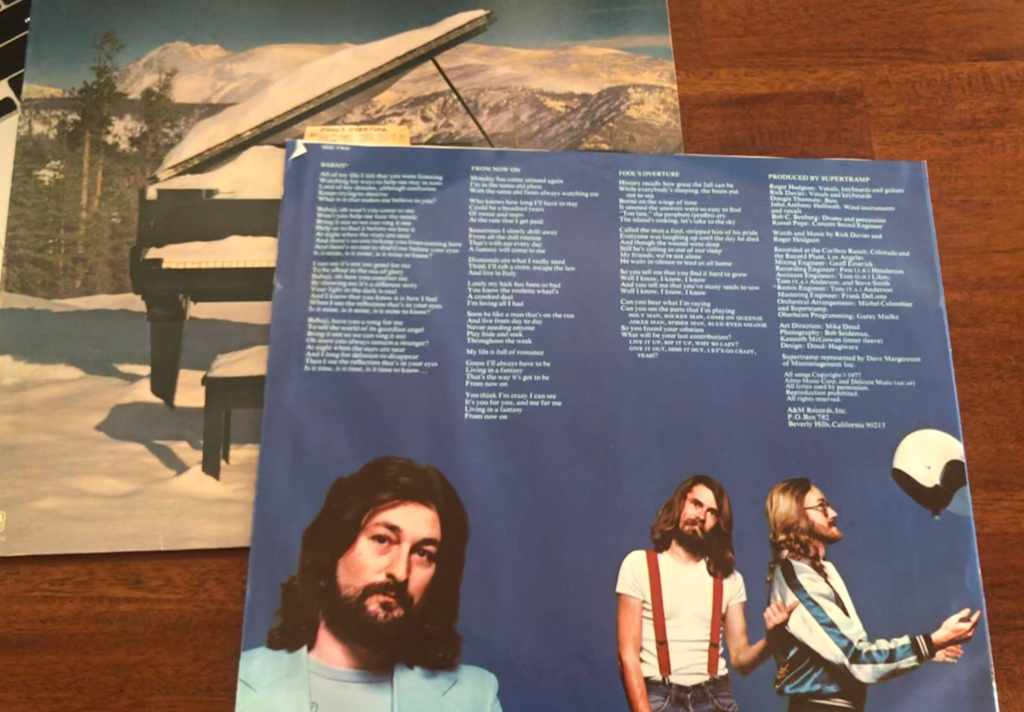
I reached into my crates and pulled one of my uncle’s records out at random to revisit. Oddly enough, I pulled out Supertramp’s album EVEN IN THE QUIETEST MOMENTS, which was recorded in Nederland, Colorado, a town that’s not far from my home. I really like the album artwork, a photograph of a snow-covered piano. According to my vigorous online research, the photo was taken at a ski lodge in Boulder County, again not far from my home. Even stranger, the album was released 44 years ago this month! I guess it’s kismet.

After admiring that album cover, I flipped the sleeve over and checked out the tracklisting. My heart kind of sank. The only track I recognized was the first one, “Give A Little Bit.” I guess I should talk a little bit about my relationship with Supertramp: I don’t really have one. Sure, I love all the singles I grew up hearing on classic rock radio, but I’ve never sat down and given one of the band’s albums a listen. My favorite Supertramp song is probably “Bloody Well Right” off of CRIME OF THE CENTURY. Looking into the band’s discography, it seems that 1979’s BREAKFAST IN AMERICA (the album they released right after EVEN IN THE QUIETEST MOMENTS) is the band’s big album. I’ve heard over half of that album’s tracks on the radio over the years.

But I’m not here to talk about BREAKFAST IN AMERICA. I’m here to discuss EVEN IN THE QUIETEST MOMENTS. The album opens as I said, with “Give A Little Bit.” Even though I’ve heard this song hundreds of times, I was surprised at how great those crisp opening guitar chords sound. This is a great way to open a record, though this song feels a decade older than it is. Rather than being a song from the year Star Wars came out, this feels like a 1960’s summer of love song. The core message of the song is very hippy-dippy and runs counter to the slightly snarkier tone of the majority of Supertramp’s songs I’ve heard over the years.

The second track, “Lover Boy,” is a piano ballad with some nice guitar tossed in for good measure. The whole track is drizzled with some syrupy strings that belie the song’s subject: the titular “lover boy.” Apparently this lover boy has read a book on seduction and uses deception to entrap women. I love the jaunty piano riff; it really grows on you and is a nice contrast to the song’s dark themes. A little over halfway through the runtime, the song has a fake out ending and when the song resumes, it’s much darker and more guitar-driven. Usually, I don’t care for tricks like that, but I thought it worked well here.

The third track, “Even in the Quietest Moments,” opens with chirping birds and a clarinet, which is strange but not unwelcome. Soon, however, the track devolves into a mystical-acoustic ballad that sounds like a parody of something off of LED ZEPPELIN III. The lyrics are addressed to God seem to be about the distance between God and man. It’s competent, but I still found myself feeling a little embarrassed to be listening to it. “Downstream” is another piano ballad, and here I should point out that EVEN IN THE QUIETEST MOMENTS does not feature Supertramp’s trademark Wurlitzer electronic piano. The zany, high energy the Wurlitzer brings to many classic Supertramp singles (“Goodbye Stranger”) is entirely missing from this record. “Downstream” is a simple love song about…taking a boat ride on a Sunday? This straightforward song frankly feels like filler.

The next track,”Babaji”, reminds me very much of George Harrison’s solo track “My Sweet Lord.” The obvious reason is the references to Indian/Hindu spiritualism but also because both songs are about “being strangers” to God and yearning to be with a higher power. Apparently, yes, I had to look this up, “Babaji” is about Mahavatar Babaji, a religious figure Supertramp’s Roger Hodgson greatly admired. There’s probably a lot going on in this song that my ignorance on the subject matter obscures, but for the most part, I think this is a solid enough track. This was released as a b-side, and it feels like one.

EVEN IN THE QUIETEST MOMENTS finishes up with two really strange tracks. The bizarre piano ballad “From Now On” and the lengthy prog track “Fool’s Overture.” The former has the strangest/laughable lyrics on the album:

“Sometimes I slowly drift away

From all the dull routine

That’s with me every day

A fantasy will come to me

Diamonds are what I really need

Think I’ll rob a store, escape the law

And live in Italy”

I like the lyrical hook and the saxophone paired with it, but this track is goofy. There’s a vocal choir that comes in near the end, too, that is like crazy icing on a batshit cat. “From Now On” is so ballsy that by the end, it convinces me that it’s not insane but actually rather awesome. Well played, Supertramp. “Fool’s Overture” clocks in at 10 minutes and 53 seconds–which, can I say: what the heck, Supertramp? Why not find an extra seven seconds and push this thing to eleven minutes? “Fool’s Overture” is a mishmash of songs/song ideas that also features sound clips of Winston Churchill. According to Wikipedia, it took five years to write, which checks out as this thing is sprawling and probably blows you away when you’re high…but honestly, it felt a bit too generic for me. Yes, a song featuring weird woodwinds, Winston Churchill, and William Blake is generic. Whenever I hear stuff like this, I think about how intricate and challenging it was to create and how eager I am for it to be over. Prog is not my favorite genre by any stretch, so maybe I’m biased, but compared to some of the prog I’ve liked over the years (Gabriel era-Genesis), this doesn’t stack up as anything other than a couple of long songs stitched together.

Overall, EVEN IN THE QUIETEST MOMENTS reveals a more subdued version of Supertramp I was unfamiliar with. Clearly, the band’s non-singles output is worth checking out, though I get the impression from this album that it’s a bit spottier than I might have thought. Still, half of the songs work for me, and other than “Fool’s Overture,” even the misses on the record were interesting.

CLASSIC ALBUMS REVISITED: REVOLVER

REVOLVER, The Beatles’ seventh studio album, just celebrated an impressive 50th anniversary earlier this month. Last night I sat down with my son and listened to it in its entirety for the first time in many years. Growing up, REVOLVER was my very first Beatles album. It was one of two CDs my parents owned for many years which means this is The Beatles album I am most familiar with. Because it was the first time my son Warren had heard an entire Beatles album, I decided to try my best to listen with new ears, not an easy task for an old Beatle-fan like myself.


For starters, I was surprised at how clean and modern REVOLVER sounds. Sure, this type of rock music isn’t what’s in vogue today, the album could still have easily been released today. I know that this isn’t a new revelation, and is, in fact, the chief aspect that makes The Beatles and their work still so relevant. But I was still nonetheless impressed with how well REVOLVER holds up. I also noted, maybe for the first time, what a fantastic bridge album REVOLVER is between the early “Yeah, Yeah, Yeah” Beatles and the drugged-out later period. The band is still trading on their moptop image/sound but there is a clear effort to craft songs that are both sonically diverse and that cover meaningful topics outside of merely wanting to hold a girl’s hand and/or being in love. There are, history tells us, several factors that contributed heavily to this evolution in the band’s sound. The first is, of course, the band’s exposure to Bob Dylan, which began a sea change in the band’s writing on RUBBER SOUL released the year before. Lennon, in particular, was increasingly trying to say more with his music thanks to Dylan’s influence. Drugs, specifically LSD, and the psychedelic counter-culture movement also played a tremendous influence on the band and REVOLVER. Lastly, I’d also say that George Harrison meeting Ravi Shankar, how expanded upon and improved Harrison’s sitar playing during the summer of 1966 also heavily influenced REVOLVER.


REVOLVER might also best be described as Harrison’s coming out party. Though his best Beatles-era songs are arguably on ABBEY ROAD, I would argue that it is REVOLVER where it becomes apparent that Harrison is just as good a songwriter as Lennon-McCartney. It’s worth noting that this is the first (and only) time that a Harrison-penned song opens a Beatles album. And what an interesting choice “Taxman” is when you consider the song’s subject matter. This is the first time The Beatles get political and it’s not about war but rather their pocketbooks! I’m not sure I would be aware of the tax situation in the UK during this period of history were in not for this song and The Rolling Stones eventual decision to be tax exiles during the recording of EXILE ON MAIN ST. Interestingly enough, unlike many protest/political songs of the era, “Taxman” is probably the closest song to remain topical even to listeners today.


Though largely considered to be the pop Beatle, the one with the keenest commercial sensibilities, even Paul McCartney gets serious on REVOLVER. True, McCartney (like Lennon) had been maturing in his songwriting with each successive album, REVOLVER features one of his darkest songs ever, “Eleanor Rigby.” Though the song was written in conjunction with Lennon, who often gets credit for being the more artistically-serious Beatle, McCartney came up with the impetus for the song. Listening to “Eleanor Rigby” with fresh ears, I was struck at how hopeless the song’s characters are. That McCartney, a wealthy young rock star, would write such a sensitive song about ordinary, lonely people is still surprising to me. Though the similarly melancholy ballad “Yesterday” gets the lion’s share of accolades, I think “Eleanor Rigby” is the better song. The arrangement is more complicated and the lyrics are more evocative. Without devolving into a simplistic story-song, “Eleanor Rigby” manages to paint the listener a few sad vignettes that cut to the very heart of loneliness and the plight of people society at large has forgotten about. Sure, the song is a bit dramatic, perhaps even a bit melodramatic, but I still get chills listening to the track’s mournful strings.
The Beatles dipped their toes into psychedelic music with “I’m Only Sleeping.” A John Lennon song about the joys of staying in bed, the song features reversed or “backward” guitar tracks, a touchstone of psychedelic music, and has an overall druggy feel to it. The song is one of the few Beatles songs that feature an explicit outsider perspective (“I’m a Loser” might be considered a proto-outsider song, “The Fool on the Hill” is a notable example, as is “You’ve Got To Hide Your Love Away”). Was the world judging Lennon because all he wanted to do was sleep or is the song really about drugs (like most things)? It’s difficult to say. During this period Lennon did reportedly enjoy getting high and staying in bed, but I’ve also read that McCartney had to frequently rouse his writing partner from bed before working on their songs. Also worth noting, the interview Lennon gave around this time in which he famously declared The Beatles “bigger than Jesus” was part of an article that contains a quote from a friend of Lennon’s who declared him the “laziest man in England.” So perhaps “I’m Only Sleeping” really is just about napping in bed. Either way, the song’s inventive use of studio trickery was foreshadowing surreal sounds the band would capture later on REVOLVER (and in their subsequent albums).


“Love You To” is Harrison’s best song on REVOLVER and one of the most daring songs the band ever produced. Though he’d used the sitar on RUBBER SOUL, to great effect on “Norwegian Wood,” it was this track where Harrison truly brought Indian music to the band’s sound. Using a sitar, a tabla (hand drum), tanpura (a special rhythm instrument), and Harrison created a sound that no doubt sounded otherworldly to the majority of Western listeners of the time. Besides launching a whole new phase of the band’s creative life, “Love You To” single-handedly popularized the genre of World Music. A mix of philosophical noodling and romantic love, the track was undoubtedly the most sexual song the band had recorded up to that point. Harrison repeatedly states “I’ll make love to you/if you want me to” in the chorus of the song.


Another key influence on The Beatles was Beach Boy Brian Wilson, whose ghost is all over McCartney’s “Here, There and Everywhere.” The most obvious Wilson-trademark found in the song are the ethereal backing vocals. But the core of the song, being in love and having that love make you a better person is almost a reflection of the themes found in Wilson’s own “God Only Knows.” Though the songs were written and recorded around the same time, this can’t be accidental, can it? A more nuanced and mature love song, “Here, There and Everywhere” takes a larger view of the impact of romantic love beyond the early pleasures of love’s first blush (like most early Beatles love songs). The track is less about how love makes one feel and more about the impact love has on one’s outlook. I think that this song is probably a better example of The Beatles doing a Beach Boys-esque song than “Back in the USSR,” which is just a straight parody. The song is nothing but further proof that the band didn’t exist in a vacuum and took cues from the work of their peers (besides Dylan).
I can’t tell you how crushed I was when I first learned that “Yellow Submarine” wasn’t written by Ringo. The rule for 99.999% of Beatles songs is that whoever is singing lead wrote the track. Sadly, Ringo only wrote two songs during his time with The Beatles, “Don’t Pass Me By” and “Octopus’s Garden.” The song is a fanciful kiddie track that began life as McCartney trying to write both a song for Ringo to sing and a Donovan-esque number. To McCartney’s credit, even though the song is pretty much nonsense, it works wonderfully with Ringo at the helm (pun intended). That this song would later go on to inspire a super-trippy animated film is just icing on the cake. I’d like to hear McCartney sing this one, though I have a hard time imagining what that would be like. Oddly, two of Ringo’s best-known Beatles songs involve the ocean, but then again England is an island and Liverpool is a port city so I suppose it’s not so odd that the boys would have a healthy interest in the sea. I love the song’s goofy little extras, like the crashing wave sound and the ringing bell. Ringo play-acting as a sailor in between verses is also a nice touch that adds to the song’s theatrical, almost pop-up book-like quality. The Beatles dabbled in so many genres that I guess it shouldn’t be surprising that they ventured into kids music.


“She Said She Said” and “And Your Bird Can Sing” are both ostensibly a dialogue taking place between a man (Lennon) and a woman. “She Said She Said” has a real druggy (acid?) feel to it in which neither party can properly connect or articulate a feeling that they are having. Though the “I know what it’s like to be dead” is definitely the proclamation of a chemically altered mind, “I know what it is to be sad” is a very real thought/feeling. The juxtaposition between the two has always fascinated me. Is the communication breakdown between the two parties the result of drugs or gender? Who can say? Further complicating matters are the fact that the song was inspired by Henry Fonda, who famously told Lennon at a party “I know what it’s like to be dead.” The song pairs nicely with “And Your Bird Can Sing” which is an indictment against materialism over a personal connection. Both songs share an awesome, iconic opening guitar riff (though “And Your Bird Can Sing” edges out “She Said She Said” in this department). In his book All We Are Saying, author David Sheff quotes Lennon as being dismissive of the song, essentially calling it all style and no substance. I disagree and think Lennon was doing what Lennon often did and disparaged his older work in favor of whatever thing he was doing at the time. I’ve always really enjoyed the line “You say you’ve seen Seven Wonders/and your bird is green.” That image always stuck with me and I picked up on that line again when I re-listened to the record.


Similarly, “Good Day Sunshine” and “Got to Get You Into My Life” are very similar McCartney tracks that feel almost like throwbacks to a quainter, simpler time. “Good Day Sunshine” has a very old-timey feel to it, both in its simplicity and with its twinkling piano and optimism. In fact, the track wouldn’t be entirely out of place on The Kinks magnum opus VILLAGE GREEN PRESERVATION SOCIETY. The shining horns on “Got to Get You Into My Life” have a similar effect, though “Got to Get You Into My Life” features a much rougher-sounding vocal performance from McCartney. It’s almost an R&B song and was famously covered by Earth, Wind, & Fire in 1978, so apparently, I’m not the only one to pick up on this fact. Paul McCartney has gone on the record to state that “Got to Get You Into My Life” is about marijuana, which I find both perplexing and oddly satisfying. Both tracks share a youthful optimism and exuberance that an older version of the band probably couldn’t pull off. McCartney would later revisit this type of old-fashioned/throwback on The White Album (“Martha My Dear” and “Ob-La-Di, Ob-La-Da”) with diminished results.


“For No One” is one of the band’s most poignant and bare-bones songs. Detailing the end of a relationship, Paul McCartney’s song perfectly captures the sadness one feels when one realizes the love is gone. Tastefully understated, the song is memorable for its achingly sad french horn solo near the end. The line “a love that should have lasted years” sounds less accusatory the older I get, which I get is an outside quality that I am bringing to the song. And yet, part of me can’t help but think that McCartney’s choice of words aid this phenomenon by being just a touch vague enough to avoid implying fault on either party. Even Lennon, who could be McCartney’s toughest critic, was a fan of “For No One.” Again, this is another track that lives in the shadow of “Yesterday,” even though I think it does essentially the same thing but better.


Much like “Got to Get You Into My Life,” the song “Dr. Robert” was about drugs. Though the latter was more obviously about drugs than the former, it’s still a bit of a secret drug song. A bit cornball in comparison to many of the band’s other drug songs, “Dr. Robert” is important because it’s ostensibly about the doctor that supplied the band with their first acid trip (a dentist who laced the band’s coffee with the drug after dinner one evening). This track is most notable (in my opinion) for the almost hypnotic quality applied to the lyrics”well, well well you’re feeling fine.” Despite not being as colorful as the band’s later substance songs, this one key feature of the song puts above most other songs of a similar theme recorded by other artists at the time.


The last Harrison-penned song on REVOLVER, “I Want To Tell You” is almost a rallying cry for his creativity. While not exactly stifled, Harrison also didn’t receive the full support of McCartney and Lennon when it came to his songs. “I Want To Tell You” is all about having a tremendous torrent of things to say and the struggle with which Harrison (and really all of us) have trying to express ourselves. There’s a dash of mysticism running through the song, no doubt an influence from his intense studying of all things Eastern. “I Want To Tell You” is a great song because even though it covers a very heady, intellectual topic, the song is still very humble in its presentation (almost low-key in many respects). While not Harrison’s best song, I’d say it was the most emblematic of who he was as an artist and as an individual: highly intellectual with a down-to-earth quality, mystical with an aura of practicality.


The final track on the album is also the best. “Tomorrow Never Knows” is a tour de force and easily in my top 5 of all-time Beatles songs. Everything about this song is crafted perfectly, from the odd effect place on Lennon’s vocals to the Indian-influenced drum pattern that Ringo uses. “Tomorrow Never Knows” is probably the first truly great studio track from a band that would soon go on to do nothing but fantastic studio-driven tracks. Using looping tape, The Beatles create an otherworldly soundscape that must have scared the crap out of all the kids tripping on acid the first time they put REVOLVER on. That this is the track to close the album makes the songs feel like an odd, beautiful sunset. The strange, mystical poetry of Lennon’s lyrics are as just a good as anything the man ever wrote. I’m sure this song is highly regarded, but I feel like his later works like “Lucy in the Sky With Diamonds” and “Strawberry Fields Forever” are more lauded. And I find that sad in a way, because “Tomorrow Never Knows” is easily the equal of both of those tracks.


Perhaps I don’t run in the right crowds, but I feel like REVOLVER is almost a forgotten masterpiece by The Beatles. RUBBER SOUL is usually the transitional Beatles record that gets the most attention, which is a shame because I think REVOLVER is the superior album. Straddling the line perfectly between both periods of the band’s creative life, REVOLVER has everything one thinks of when they think of The Beatles.

Classic Albums Revisited: THE KINKS ARE THE VILLAGE GREEN PRESERVATION SOCIETY

On  November 22, 1968 The Kinks released their sixth album THE KINKS ARE THE VILLAGE GREEN PRESERVATION SOCIETY (hence to be referred to as VILLAGE GREEN). Upon its release the album was branded a flop and the world moved on. But like a lot of great art, time has been kind to VILLAGE GREEN, and the album is now regarded as one of the band’s best efforts.

VILLAGE GREEN is a very (very, very) English record. It’s also a concept album. These two factors probably contributed to it’s poor reception here in America. Singer-songwriter Ray Davies, who wrote all the songs on the album, celebrates the traditional English country-village (the “Village Green” which is brought up throughout the album), while at the same time lamenting and mourning it’s disappearance. It’s difficult to tell exactly how much of Davies bemoaning is genuine and how much is ironic. The album opens with the song, “The Village Green Preservation Society” which, though sung in a very sincere manner…if clearly meant to be tongue in cheek with it’s list of things the band (as the Preservation Society) wishes to protect: draft beer, china shops, custard pie, strawberry jam (and all different varieties), Sherlock Holmes (and Moriarty), and the whole damn “English speaking vernacular.” It’s all a bit extreme, including the assertion that this “society” is also the “skyscraper condemnation affiliate/God save Tudor houses, antique tables and billiards.”

And yet, even though the song is a bit ridiculous, to the extent that it seems to be a parody…in comes the chorus: “Preserving the old ways from being abused/Protecting the new ways for me and for you/What more can we do?” and I begin to wonder if perhaps Davies is only half poking fun. The answer can be found on the rest of the album, which is nearly 100% earnest in it’s assertion that the times are changing…and it kinda sucks.

Less about “green” spaces transforming into modern skyscrapers (though that’s in there too), VILLAGE GREEN is about how time and the change it brings effects one personal life. Ray Davies is a young-man beginning to realize he’s getting older. There are two themes of VILLAGE GREEN, both are very much intertwined. The first thing the album is about is time. The passage of time, the marking of time, the struggle against the change time brings, and finally the acceptance that one must grow older. The second theme of the album is photography, specifically as a reaction to time.

On a majority of the record the subject of photography/photos/taking pictures comes up. The question Davies seems to be asking throughout is: why do we take photographs? Is it because we love each other (like in “Picture Book” a song so pro-photograph it’s no wonder HP included it in a 2004 digital photography ad campaign) OR do we take photos for darker, more selfish reasons (like in the album closer “People Take Pictures of Each Other”)?

Davies and the rest of The Kinks seem to think it’s a little of both. “Picture Book” is a bouncy, glorious ode-of a song about looking back on one’s life via a big book of pictures. Though the chorus is a bit dark “pictures of each other/to prove we love each other,” the content of the photos described in the song are all seemingly random snapshots of our lives. It’s almost like photography as an extension of our memories. After all, if we don’t remember something, it’s like it never happened. And just like a picture of “a holiday in August/outside a bed and breakfast in sunny Southend,” our memories can be inexplicably random (why DO we remember the odd little things we remember?).

Again, not a bit of “green” on THE VILLAGE GREEN.

The darker side of photography, however, is found in “People Take Pictures of Each Other” (which actually seems like it should be the title of the more well known “Picture Book”). The song has a soft, French-like quality about it. Davies sings about how “People take pictures of the Summer/Just in case someone thought they had missed it/Just to proved that it really existed.” Which leads us to a world or mindset where, it’s not a question of “if you don’t remember it, it didn’t happen” but rather, to a place where “if you have no photographic proof of it…it didn’t happen.” I find that many people in my generation and beyond are obsessed with photos, so much so that many people (parents at a dance recital) agonize so much over the photos that they miss the actual moment. The song also touches on the albums other theme, of time when later one Davies sings: “You can’t picture love that you took from me/When we were young and the world was free/Pictures of things as they used to be/Don’t show me no more, please.” That’s a bold, and frankly powerful lyric…and really encapsulates the complexity of VILLAGE GREEN. The album goes from “Picture Book,” a love letter to photographs…and ends thirteen songs later with the exclamation “show me no more, please.”

That’s why this record is so fucking great. It’s this giant, complex mediation of life and death, disguised as a pop record.

“Do You Remember Walter?” has nothing to do with photos, but it’s a central track to the record. Whereas “The Village Green Preservation Society” is all about trying to hold onto the past, “Do You Remember Walter?” is a frighteningly realistic look at how that fight ALWAYS ends. The song is one man’s recollection of his old school chum, Walter. Walter and the song’s narrator were once young and idealistic–they were going to “fight the world and be free,” with the goal of saving their money and buying a ship to sail the world! Now he’s married and fat, in bed by 8:30. He’s not the cool guy that smoked and drank, and had a bunch of fun with his “mates.” Now he’s this empty shell of the free-spirited kid he once was. And, as the narrator laments, “Walter, you are just an echo of a world I knew so long ago/If you saw me now you wouldn’t even know my name.” This suggests to me, that the narrator–like Walter, lost that battle against time. There is a brief respite from the gloom, tucked away at the end of “Do You Remember Walter?” when Davies sings: “And if I talked about the old times you’d get bored and you ll have nothing more to say/Yes people often change, but memories of people can remain.” Which, in a way, reflects on the albums other theme of photography, in that like our memories, photos can preserve events AND people in the past forever. So Walter is gone, but never forgotten.

A bit of hope.

“Village Green” is a slower song, one that’s essentially a list of all thing country things that the narrator/Davies misses about pastoral Brittan. It’s a good song, notable for mentioning the titular green-space AND also referencing photographs: “American tourists flock to see the village green/They snap their photographs and say gawd darn it/Isn’t it a pretty scene?”

The Kinks ape The Yardbirds on “The Last of the Steam-Powered Trains” which shares many thematic similarities to “Do You Remember Walter?” It’s a bluesy-harmonica fueled stomp that finds Davies proclaiming that he is the last “of the good, old fashioned, steam-powered trains.” This of course, is used as a metaphor for Davies/the narrator’s staunch stand against the endless parade of time: “I’m the last of the good old renegades/All my friends are all middle class and grey/But I live in a museum, so I’m okay.” It’s about trains, but it’s also about being that last holdout against growing up and adult responsibilities.

But it’s not all heavy on VILLAGE GREEN. The album has fifteen tracks, and some have very little to do with any larger theme (except in the most abstract sense). Of these, I enjoy the vaudevillian “Sitting By the Riverside.” With it’s heavy use of keyboard (there’s a great freak-out moment mid-way the song, when the keyboard reaches this climax…this thunderous peak, then crashes and the vocals kick back in, it’s fucking great) and laid-back vocal harmonies, this song reminds me of the Beatles-throwback songs like “Your Mother Should Know” or “When I’m Sixty-Four,” in that it’s a rock band playing a song in a style their parents would have liked. I always find those kind of songs fascinating.

Another non-theme related song I find really interesting is “Big Sky.” “Big Sky” is a trippy, near-psychedelic song–that’s nearly spoken-word. Davies croons and wails about all the injustice/terrible things that the song’s “character” the sky (Big Sky) looks down upon…and shrugs. He shrugs because he’s, well because he’s just so gosh darn big, and our problems are just so small. Is Big Sky God? Does God, like Big Sky, see our problems and find him/her/itself too powerful or mighty to help? Or is Davies being a bit sarcastic, is Big Sky not really overwhelmed but rather complacent?

“People lift up their hands and they look up to the big sky/But big sky is too big to sympathize/Big Sky’s too occupied/Though he would like to try/And he feels bad inside/Big sky’s too big to cry.”

What is Big Sky “too occupied” doing? Is he too busy staring down at our suffering to do anything about it? Maybe God’s hypnotized in such a manner, maybe that’s why we have war and disease and suffering. Then again, isn’t that what we all do? Don’t we as people look at other suffering and throw our hands up and say “I’m too busy to help!” What are we too busy doing? If The Kink’s “Big Sky” is God, then we were certainly made in his/her/it’s image.

From contemplating such large, theological questions, The Kinks switch over to the “Star-fucker” phenomenon on the song “Starstruck.” Which of course is about a girl who runs around, going nuts because she’s starstruck. Other album oddities include a song about fat cat (“Phenomenal Cat”), and an Orwellian-ode to Animal control of the world (“Animal Farm”). All three of these tracks make fantastic use of the mellotron–which allowed the band to simulate woodwind instruments (though they sounded pretty real to me).

I’ve probably over-thought this record. I know I’m misrepresenting it–it’s not a dodgy, stuffy old record with a lot of things to “say.” VILLAGE GREEN is just a rich, detailed, thought-provoking piece of art that, like a good painting or film–can stimulate the mind and, if you chose…give you something to think about.

Or you can hum along with it. It’s full of wonderful, beautiful hooks. VILLAGE GREEN is a very literate, yet very lively rock record. And we all know how few of THOSE are being made today. What do I have to do, put it in your hands? Go. Get it. Listen.

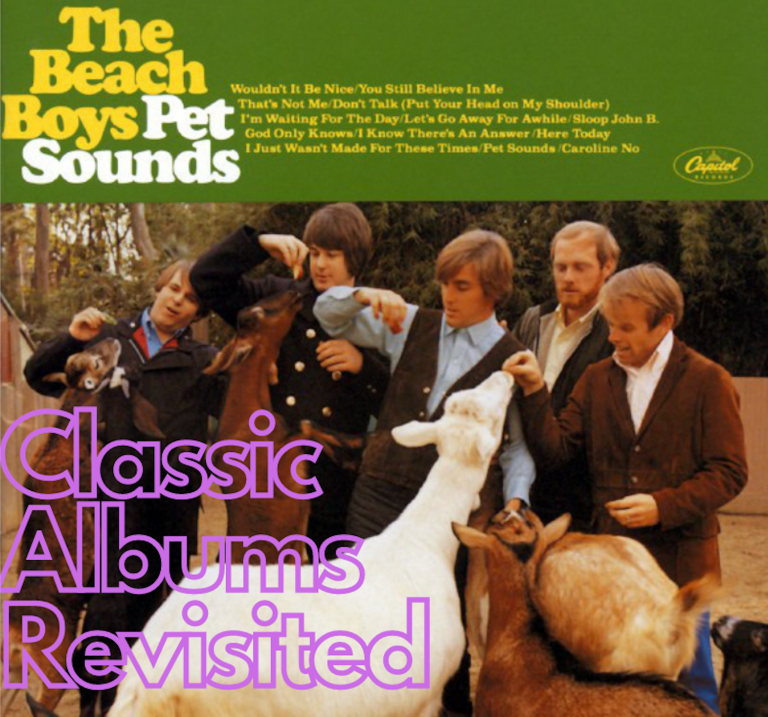
Classic Albums Revisited: PET SOUNDS

For the past few years I’ve wanted to write an epic, all-encompassing essay about The Beach Boys’ classic album PET SOUNDS.  I’ve sat down on at least two occasions and actually started, only to give up in disgust.  It seems like everything that could be said about has been said, by people far more knowledgable than myself, so why bother? Because I can’t stop listening and thinking about PET SOUNDS.  My adoration for this record has long since moved past obsession and I guess I want to try to make sense of how that happened.

Like all good art, PET SOUNDS is best described as a reflecting pool–esthetically beautiful and mirror-like in that we can see some of ourselves within it.  Sorting fact from legend in regards to it’s creation/recording is almost beyond impossible at this point.  It’s all too easy to say that PET SOUNDS is the singular work of one brilliant, tragic genius.  As an American, the notion that a complex, challenging piece of work springing from one rebellious individual is both romantic and affirming of our continental-myth of the “lone cowboy.”  On the other hand, the years have been kind to PET SOUNDS, much kinder than many of the people involved in creating it could have ever imagined, as a result many people have stepped up and claimed credit for an album they openly ridiculed during it’s inception.

PET SOUNDS is sort of the bastard son few people wanted to acknowledge at it’s birth–but later, as it matured and did good by itself–well, then many were practically falling over themselves to establish themselves as it’s parent. Does it matter that Al Jardine may or may not have insisted The Beach Boys include “Sloop John B” on the record? Or that he (or Carl) may have been solely responsible for it’s amazing arrangement?  At this stage in my life, my appreciation for PET SOUNDS, I don’t care about these matters.  All that is important for me is that PET SOUNDS exists, vacuum sealed from time and the bitter in-fighting of songwriters, musicians, arrangers, producers, studio technicians, and hangers-on.

Released in May of 1966, PET SOUNDS did not exist for me until the early 2000’s when I happened upon it in my Uncle’s CD collection.  I was in Nashville, trying figure out (among other things) who I was and what the hell I was doing.  I gave it a brief listen, made myself a copy, and promptly forgot all about it.  I’ve always been a “Beatles person.”  Growing up, The Beach Boys were that lame, striped-shirt-wearing novelty band that briefly styled themselves as “The American Beatles.”  People (mostly rock critics from Rolling Stone magazine) would, from time to time, blow my mind by placing PET SOUNDS near the top of many “Best Albums” lists, but otherwise–The Beach Boys had little credibility.  The only place I ever heard them was on the local golden-oldies radio station, placed strategically between Herman’s Hermits and Sam the Sham and the Pharaohs.

I still cannot recall exactly what compelled me to dust off my copy of PET SOUNDS, but around 2008 I did.   Almost everything stupid (for lack of a better word) about The Beach Boys is missing from this record.  There are no dated, lame-ass novelty songs about surfing or hot-rodding.  No, PET SOUNDS is 13 songs about love, the confusion of youth, self-doubt, self-realization, loneliness, and also “Sloop John B” is tacked on (thanks Al/Carl).  The music is lush, full of complex and achingly beautiful arrangements.

Lyrically, PET SOUNDS is almost the exact opposite of the music–the lyrics are so simple they sometimes strike me as slightly moronic.  I mean that in the best way possible, sort of like how people always remark how many startling truisms spring from the mouths of very young children.  The lyrical content of PET SOUNDS is simple but never basic, the observations aren’t plain and vanilla–but shockingly universal.

And that, I think, is why I’ve been obsessing about it these past few years (and why older people have been obsessing about it for decades).

The album opener, “Wouldn’t It Be Nice” is probably the most recognized track, and a perfect example of what I’m talking about.  The song is about first love, not silly puppy love, but actual honest-to-god love.  Anyone who’s ever felt that for the first time can completely understand the song, which is about the yearning to essentially always feel that feeling by being able to spend every minute of every hour with your lover.  This song encapsulates a very real feeling I think just about everyone has had.  And even though the sentiment may not be smart or realistic, that’s not the point–“Wouldn’t It Be Nice” is an explanation for every stupid teenager who’s ever run off and gotten married.  Still, an album filled with this sort of idealized romantic love wouldn’t be emotionally satisfying or realistic.  PET SOUNDS takes things further than 99% of pop albums (up to that time and since) with the very next song, “You Still Believe In Me.”

“You Still Believe In Me” opens with a confession that the song’s narrator has completely fucked up–and yet she still loves him.  Here, the wonder is not in the bliss of love but the endurance of love.  He tries, promises, and fails…and yet she still believes in him. “That’s Not Me” is another song about failure; this time, the song’s narrator has decided to give up chasing foolish impulses (saying “That’s not me”).  More than just a song of redemption, what impresses me the most about “That’s Not Me” is the self-realization that one’s dreams (and their pursuit) can not only be harmful but also maybe the opposite of what we really want. Stoned or sober, that’s a mind-blowing realization.

This is what self-realization looks like, kids.

And then there is “God Only Knows.”  Not only is it hauntingly beautiful musically, but it’s astonishingly rational while still being romantic at the same time.  Unlike a traditional pop-love song where the singer expounds about how he can’t live without the love of his life, “God Only Knows” acknowledges the fact that both he and the world would go on spinning without her, but he’s eternally grateful that he doesn’t have to be without her (because God only know where he’d be without her). I can live without you, but I don’t want to is infinitely more romantic than the foolish adolescent declaration of “I can’t live, if living is without you” (sorry Badfinger).  And you know, if PET SOUNDS was just about the complexities of love it would still be a damn good album–but it’s the introspective stuff that really pushes the album from “good” to “masterpiece.”

“I Know There’s An Answer” is about the search for the meaning of both life and self.  It’s about all those Nowhere Men sitting in their Nowhere Land, and how we’re all lost and adrift in our lives.  There is no magic bullet answer that’s going to fix everything and make us happy, we have to save ourselves with our own answer.  Also, there’s no way of helping all the lonely people of the world without first helping yourself.

And much like “You Still Believe in Me” responds to “Wouldn’t It Be Nice,” the song “I Just Wasn’t Made For These Times” responds to “I Know There’s An Answer.”   “I Just Wasn’t Made For These Times” isn’t just my favorite song on PET SOUNDS, it’s also my all-time favorite Beach Boys song.  “I Know There’s An Answer” affirms that yes, there is an answer for all of us, but “I Just Wasn’t Made For These Times” is about what happens when we can’t find that answer.  It’s about failure and self-doubt.  It’s about feeling absolutely stuck–as an artist, lover, lover of life.  It’s about the profound sadness and dissatisfaction that stalk all of us throughout our lives.  And mostly, it’s about that feeling we all have at least once in our lives, that we don’t fit in or belong anywhere.  If you’re the least bit human, you will find yourself relating to this song.  And while the song is, on the surface very sad, I find it one of the most comforting pieces of music ever written.  Not just in the misery-loves-company sort of way (though I suppose there is a great deal of that), no–“I Just Wasn’t Made For These Times” is like a music hug for me because it lets me know that I’m not alone in feeling lost and sad.

Lastly, there is the bittersweetness of “Caroline No.”  It’s the final track on the album, and it’s all about the terrible way time strips us of the things we cherish the most.   It’s heartbreakingly sad, and every time I go back to my hometown, I’m reminded of Thomas Wolfe’s “You Can’t Go Home Again.”  Again, it’s the comforting universality of the song’s sentiment that gives the song its power.  Rather than struggle for a cheesy redemptive silver lining, the “Caroline No” does us the public service of letting the listener know that that’s just how life/the human condition is.  Rarely does commercial art, let alone pop music, deal with just weighty (and frankly unpleasant) topics without resorting to some kind of cliched “happy ending.”  What do unrealistic portrayals of life and love really give us, beyond a fleeting bit of pleasure?  They doom us to even greater sorrow, hoisted up by a Hollywood ending none of us are going to get.  The braver thing, I think, is to stare at both our souls and our sorrow right in the face.  So in that respect, PET SOUNDS is probably the only mirror I’ll ever need.