“Houdini” by Eminem

Even though I was never into Eminem, when he dropped his latest single, “Houdini,” I found myself giving it a listen. What would Eminem sound like in 2024? The rapper has been putting out new music since his Slim Shady days, but it never penetrated my curated internet bubble. These days, I’m constantly on the hunt for new music so I gave it a listen. 

This preamble is important, I swear. 

I put “Houdini” on and immediately liked it. I put it on repeat a few times and had a good time chuckling along with Eminem’s antics. The song is built around a sample of the classic Steve Miller Band track “Abracadabra.” I grew up on classic rock and am somewhat of an authority on this increasingly irrelevant radio format. So when I tell you that the Steve Miller Band mostly sucks and “Abracadabra” is one of the era’s worst songs, please take that as an opinion but an opinion based on years of clinical research in my dad’s mobile laboratory (i.e., shitty old Chevy). 

However, like a lot of people these days, I’m aware of the importance of recycling from an environmental perspective, so part of my initial admiration of “Houdini” was how it took this trash and reused it. Rappers using samples of classic rock songs is nothing new, but Eminem does the thing I enjoy where he uses an old song and builds upon the themes surrounding the sample. So when penning a song called “Houdini,” it kinda rules to use a sample of a song also thematically related to magic. This is my one compliment for “Houdini.”

Nostalgia is a helluva drug. Listening to “Houdini” was a bit like a magic trick–I found myself instantly transported to 2002. With that transportation, my mind regressed a bit back to 2002. However, it’s not 2002, and once I remembered that, I found myself pretty disappointed by “Houdini.” I can laugh at a line like “My transgender cat’s Siamese/Identifies as black, but acts Chinese” because, in a vacuum, that’s funny. But I also know that transgender people don’t have the luxury of living in a vacuum, especially in 2024. The more I thought about it, the stupider it became to me that a legendary millionaire rapper is still picking on people who are merely different. Eminem’s punching down on gay people, transgender people, women, etc., in this track feels like the desperate act of an artist trying to stay in the conversation. 

From his previous work, we know that Eminem isn’t a Trump supporter, yet a track like “Houdini” only really appeals to those sorts of people. On “Houdini,” Eminem invokes the specter of cancel culture, which is particularly funny to me because the “cancel culture” he’s invoking is about the only thing making “Houdini” somewhat edgy. 

So if “Houdini” isn’t particularly edgy (in a real way) and attacks people who a large swath of society enjoys attacking…is it at least good art? Not particularly. Other than recycling a crap song into a slightly less crappy one, “Houdini” is just another Slim Shady song. Eminem is once again “back,” and his enemies are in big trouble. Yawn. We’ve been here and done that before. Even the music video is just a blatant rip-off/callback to an older video. 

Glory days, they’ll pass you by in the wink of a young girl’s eye. 


It’s the bridge of “Houdini” where the whole thing completely falls apart when Eminem says, “Sometimes I wonder what the old me’d say, If he could see the way shit is today.” Well, I have good news for everyone: there’s a very real and very simple way to know what the old Enimen would say about the world today. It’s called “Houdini,” and you can hear it online whenever you want.

Now, don’t get me wrong, you can be an artist without doing a lot of growing and changing. I love that every AC/DC album sounds the same. The Ramones found success and didn’t alter too much from their formula, just like Mr. Shady. The difference is that, for the most part, these were fun-loving party bands. 

Eminem was a source of cultural commentary for decades. However, the cultural perspective from which his art comes is that of a young man in 2002 who is trying to be edgy. It would be more interesting if the music he made came from the place he’s at now. We know his daughter just got married; how does Slim Shady feel about his little girl getting married? That would be more interesting but likely not something the mouthbreathers he’s selling to would care to find out. 

Will the real Slim Shady please sit down?
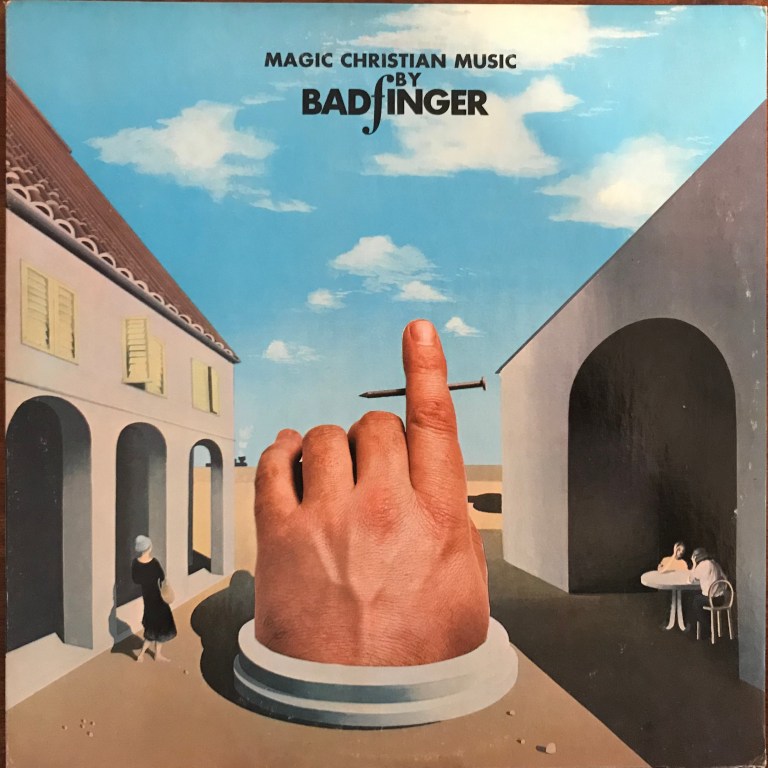
MAGIC CHRISTIAN MUSIC by Badfinger

It’s time for another installment of “David’s Records,” wherein I reach into my crates and pull out one of my Uncle’s records at random to revisit. This time I choose the 1970 album MAGIC CHRISTIAN MUSIC by Badfinger. If I’m honest, when I pulled this one out, I nearly stuck it back. But why would I do that? Do I hate Badfinger? Not at all. I quite like what little of Badfinger I’ve heard. The reason I dreaded writing a post on this record is all the Badfinger baggage. The music industry is notoriously a ravenous machine designed to chew artists up and spit them out jaded, addicted, and destitute. But what happened to Badfinger is on a whole other level of bad. I’m going to skip over all that stuff as I feel like most people who happen upon this will know the entire story. If you don’t, take an antidepressant and Google the band.

Badfinger famously began their career as The Iveys and had the honor of being the most successful band signed to Apple Records not named The Beatles. Being handpicked for success by The Beatles at the height of their fame only to fall as tragically as Badfinger did is the kind of story made for Hollywood. I seriously can’t believe we haven’t gotten a biopic about them. Oh, shoot…there I go getting sucked back into the sad tale of Badfinger.

MAGIC CHRISTIAN MUSIC is a bizarre title referencing a 1969 Peter Sellers film titled The Magic Christian. For years (decades actually), I always assumed that MAGIC CHRISTIAN MUSIC was that film’s soundtrack. The Magic Christian co-stars Ringo Starr and features three songs from MAGIC CHRISTIAN MUSIC. However, according to my extensive Google research, this record is not the official soundtrack. Apple was scheduled to release the official soundtrack, but the addition of one song prevented them from doing this (the music biz is hard), so MAGIC CHRISTIAN MUSIC was released instead. Paul McCartney produced the three tracks used in The Magic Christian, and he even wrote one.

The album opens with “Come and Get It,” the song Paul wrote and gave to the band. Paul wrote this song during the ABBEY ROAD sessions, and it sounds like that era McCartney. I think my first exposure to this song was hearing it in a commercial sometime during the 1990s. When the Beatles Anthology came out, it featured a rough mix of this song, and I was blown away by it. I couldn’t help but think, “why didn’t this song make it onto the album?” Well, it’s because Paul gave it to Badfinger because his record label had signed them, of course. All of the tracks on MAGIC CHRISTIAN MUSIC sound very Beatle-esque however, this one straight up sounds like The Beatles.

I like “Crimson Ship,” but I honestly cannot figure out what it’s about. There’s mention of crosses and resurrection in the lyrics, which makes me think there’s some Jesus stuff going on in the song, but I’ve never heard of anything in Christianity referred to as a crimson ship. I’m assuming if I were more religious and/or Welsh, I’d get the reference. The guitar hook is cool. The next song, “Dear Angie,” sounds like an earlier Beatles track John Lennon might have written for RUBBER SOUL. It’s very much a boy-loves-a-girl song, and the song ends on the punchline that the thing he’s got to tell her is, “I love you, you’re my all, that’s all.” While not as clever as a classic Beatles love song (seriously, they rhyme “all” with “all”), this is a decent track, and the vocals sound remarkably like Lennon in places.

The next song, “Fisherman,” is the first track on the album I had not heard before picking up this album. Unfortunately, it is not very good. It sort of drones on and seems to ape those Beatles songs that are spacey and weird but also about quaint English people. It feels very forced and is pretty dull. “Midnight Sun,” on the other hand, is an excellent breath of fresh air after such a monotonous track. The drums on this track sound fantastic. The 1970s were the zenith for drummers on record; you had guys like Keith Moon and John Bonham just absolutely killing it on the drums, and on “Midnight Sun,” Mike Gibbins is also banging his heart out. And I love it.

“Beautiful and Blue” is a decent attempt at a Lennon psych-rock. Sadly, the lyrics are pretty standard guess-the-rhyme fair that’s too predictable. It sounds nice but is rather hollow. “Rock of Ages” is another barnburner in the vein of “Midnight Sun,” although this track’s just a touch better because it’s the second track produced by McCartney. I think that this is probably my favorite track on the album. It’s not the catchiest and doesn’t have the best lyrics, but it’s a perfect evolution of British rock. I don’t think a mid-1970s Beatles album would have sounded like “Rock of Ages,” but when I imagine a 1977 Beatles record, this is what my brain conjures.

The next song, “Carry On Till Tomorrow,” is the third and final track produced by McCartney, and it’s absolutely gorgeous. Lyrically somber, the song’s structure is interesting with soaring vocals, strumming acoustic guitar complemented by a great electric solo. A sad song about keeping going in the face of heartbreak/adversity, this song is Badfingers “Let It Be.” And while this might be blasphemy, but I think I might like it slightly more than “Let It Be.” This achingly sad song is followed up with “I’m In Love,” a simple, goofy song about being in love that frankly sounds like a Monkees castoff. The rhymes are simple, and the sentiment is simple; it’s disposable bubblegum pop at its finest. The drums are once again killer (those crashing high hats!), but overall, the emotional whiplash induced by going from such a serious track to this pop fluff ultimately hurts the song and the album’s flow.

There’s more emotional whiplash when the album veers back into sad and moving with “Walk Out in the Rain,” which I appreciate for its stripped-down, honest feeling. That said, the screeching “be mineeee!” is over the top and kills the song’s mood. The call and response harmonies do a lot to salvage the song, but this one feels like a re-write or two away from being a great song. “Angelique” is a mid-tempo snoozer that feels like album filler and is a less exciting version of “Dear Angie.” One of the more interesting tracks on the album’s b-side, “Knocking Down Our Home,” sounds like a combination of McCartney’s WHITE ALBUM “Honey Pie” and VILLAGE GREEN-era Kinks. This song has the kind of variety MAGIC CHRISTIAN MUSIC desperately needed; it’s a shame the band didn’t try a few more tracks like this outside of rockers and ballads.

Speaking of rockers, the final big rockers on the album “Give it a Try” is a retread of “Midnight Sun” and “Rock of Ages.” It’s not a bad song, but it’s the weakest rocker on the album. The album closes with “Maybe Tomorrow,” which, like “Give it a Try,” is the weakest ballad on the album. Again, it’s not terrible, but on an album with “Carry on Till Tomorrow,” it feels lesser. Also, as a somewhat writer myself, it baffles me the band would choose to have two songs on the same record that are so similar that also feature the word “tomorrow” in their title. Of the two tomorrow ballads, “Maybe Tomorrow” is the more classically Beatles-esque.

As I put the record back in the sleeve, I couldn’t help but feel as if I’ve been a bit too hard on MAGIC CHRISTIAN MUSIC. Frankly, I think Badfinger’s association with The Beatles was more of a hindrance than a help. I believe having McCartney writing and producing and generally giving the band a leg up made folks (myself included) view the band with more of a critical eye. For a band’s second album, this is great, and all of these songs are way better than anything written by the countless other Beatles-inspired bands that came after them. Compare Badfinger’s second record to the second record Jet put out.

Listening to MAGIC CHRISTIAN MUSIC has piqued my curiosity for the band. Before listening to writing this post, my only exposure to Badfinger was a Greatest Hits compilation I own. However, MAGIC CHRISTIAN MUSIC has enough interesting things going on in the non-single tracks to convince me I need to sit down and go through the band’s entire discography. The good news is that thanks to my Uncle, I have all the band’s other releases. So this is not the last we’ll hear from Badfinger here in the Record Dungeon.

SACCHARINE by Pinkshift

The tug of nostalgia is strong, and its pull seems to get magnified for me with each passing year. I guess this is what they call getting old. Anyway, someone online suggested that I check out Pinkshift, a modern emo-rock/pop-punk band from Baltimore. What convinced me to check them out was the comparison to early No Doubt, which is a somewhat unfortunate comparison that’s 100% because the band has a female lead singer. Pinkshift is more punk than No Doubt ever was.

The band recently released an EP of five songs, SACCHARINE, that perfectly captures the spirit of those early 2000’s era punk/emo bands that I used to hear on MySpace while hanging out in my dorm. The fact that kids these days are still interested in making this kind of music really warms my heart. Oh, and “i’m gonna tell my therapist on you” kicks major, major ass. The snark, the sneering attitude, and the swagger of that track are worth the price of admission. The dark and brooding “Rainwalk” feels like a My Chemical Romance track. Now that I think about it, MCR is a more apt comparison to make than No Doubt. But all of these comparisons are kinda lazy and don’t do Pinkshift justice.

Listening to “Mars” makes me wanna bring out the guyliner, and I never wore guyliner. I read an interview with the band online where lead singer Ashrita Kumar credits the pandemic with “i’m gonna tell my therapist on you,” blowing up online. I’m not sure if there’s a place in the current cultural zeitgeist for a 2000’s inspired emo band, but if there was ever going to be a moment for this type of music to get popular again, this does feel like the time. The musicianship, lyrics, overall vibe are all there.

Give this EP a spin and if you’re so inclined, go on Bandcamp and pick it up like I did and support these kids.

THE RAMBLIN’ MAN by Waylon Jennings

Well, I did it again. I reached into my crates and pulled one of my Uncle’s records out at random to revisit. Interestingly, the record I chose, THE RAMBLIN’ MAN by Waylon Jennings, belonged to my grandfather and was added to David’s collection upon his father’s death. I’m not a big country music fan, but I must admit, I do like some of the classic country recorded in the late 1960s and early 1970s. Waylon Jennings is one of those outlaw country dudes whose name I recognize but of whom I know nothing. What little I have heard from Jennings comes from an EP he did in the 1990s (released in 2013) with the alt-country outfit Old 97’s. Apparently, however, THE RAMBLIN’ MAN is one of Jennings’s more commercially successful and mainstream records. Considering my grandfather bought it, the record must have been pretty popular at the time of its release in 1974. A few minutes of research online reveals that THE RAMBLIN’ MAN was the follow-up to Jennings 1973 classic HONKY TONK HEROES. It seems that in many ways, Waylon Jennings was a proto-modern country star, ushering in the current era of country by both being more mainstream and (seemingly) niche by operating as an “outlaw” country star.

THE RAMBLIN’ MAN opens with “I’m A Ramblin’ Man,” which, if I’m honest, it sounded to me like a Bud Lite version of Johnny Cash’s “I’ve Been Everywhere.” So I looked into it, and it turns out Cash’s song came out in 1996, well after this album came out. But it turns out “I’ve Been Everywhere” is an Australian song that came out in 1959 (featuring cities in Australia rather than US cities). Either way, “I’m A Ramblin’ Man” has a thumping bassline and probably sounds awesome while you’re cruising the backroads of America. But, it’s weird because the song is about how much traveling he does while also serves as a warning that you shouldn’t fall in love with him because, as the song states, he does so much rambling.

The second and third tracks I consider to be companion pieces. The second track, “Rainy Day Woman,” is about a woman who, to quote the lyrics, “she ain’t happy, ‘Til she finds something wrong and someone to blame, If it ain’t one thing it’s another one on the way.” Interestingly, however, he describes this woman as “a friend of mine.” Part of this song seems like it’s about a woman that only focuses on the negative things but, on the other hand, is a kind of safe port in the storm. This is not a great song. The third track, “Cloudy Days,” flips the script, and the song’s protagonist is trapped in a negative headspace where every day is a cloudy day (“Life’s just become cloudy days”) because his woman has presumably left him. Despite being a downer, the song’s glass-half-full optimism (“But you know they say if rain don’t come, Then love has no chance to grow”) won me over.

For the fourth track, Jennings chose to cover The Allman Brothers Band classic “Midnight Rider.” That track was only four years old when THE RAMBLIN’ MAN was released, which I think is important to consider. Today in 2021, there’s nothing risky or exciting about a country star covering a southern rock band like The Allman Brothers, but I suspect this was a bit surprising in 1974. The cover is…fine. The guitar work is obviously more stripped-down/less impressive. One strength that it has over the original, however, is Jennings whiskey-soaked vocals. Jennings’s voice is both traditionally masculine and robust, but there’s a tender gentleness about it as well. Listening to “Midnight Rider” makes me wish Jennings had done a whole album of this kind of covers (maybe he did?).

“Oklahoma Sunshine” is the best song on the album full-stop. Probably because I identify so much with the song’s protagonist who is trapped in a “God-forsaken city” but at night dreams an idealized version of his simpler life back home in Oklahoma. The song isn’t just about yearning for the country while being trapped in a city; it’s about missing an idealized version of the past and yourself. The song’s soaring chorus belies much of the melancholy, but it all still lands like a gut punch every time I listen to it. People often make the comparison that country is really just the blues for white people; for me, “Oklahoma Sunshine” proves this point.

Whereas “Oklahoma Sunshine” is a sad song done right, “The Hunger” is kinda the opposite. There’s good stuff in some of the lyrics (“Her beauty has been eaten by the hunger, And the acid winds of time”), but for the most part, I feel icky listening to it, which is probably the point. There’s probably a good song somewhere about a woman’s physical beauty fading as she continually fails to find (romantic?) fulfillment, but this track ain’t it. Likewise, “I Can’t Keep My Hands Off of You” is the kind of sad-sack country song that feels extremely cliche. Also, the lyrics are pretty creepy–he can’t keep his hands off his woman, AND she looks “just like a baby in a cradle.” That’s a big “eww” for me.

“Memories of You and I” pulls me back in with its mournful harmonica and confessional-style lyrics. Drink, money, and fame are no match for the painful memories of leaving this woman. There’s no bitterness in Jennings’s delivery or the lyrics, just achingly crushing sadness and regret. Simple and effective, “Memories of You and I” lays the blame where it belongs and is all the better for it. “It’ll Be Her” is also a simple yet very effective song about a woman who’s the absolute best. Both of these tracks showcase how much a performer makes a song. If I sang these (incredibly simple) songs, most people would feel very little, but he adds this whole layer of complexity with just his voice when Jennings tackles these songs.

THE RAMBLIN’ MAN closes with the song “Amanda.” The song is both a lament for his woman’s choice of a lover (“Fate should have made you a gentleman’s wife”) and a sober assessment of his life as a musician/getting older. It’s a good, sadly sweet song and the perfect way to close the album. However, I would be remiss if I didn’t add that my Uncle’s first daughter is named Amanda, and this probably made the song more emotional for me than it would be for most listeners.

Overall, I enjoyed THE RAMBLIN’ MAN. The instrumental and production side of things isn’t super interesting or varied, and the lyrics are primarily very simple, but Waylon Jennings sells the hell out of the songs. Even on the songs that I didn’t care for, the reason I didn’t care for them had nothing to do with Jennings and the authenticity he brings. And for me, “Oklahoma Sunshine” is an all-timer I can see myself revisiting again and again as time passes. Certain songs hit you harder and more emotional as you grow older, and time robs you of the things we all take for granted. So I can see myself sobbing like a baby while I listen to “Oklahoma Sunshine” in a nursing home one day.

An album can be a portal to another time and place. THE RAMBLIN’ MAN was listened to and enjoyed by my grandfather and my Uncle, and now me. It would have been cool to have heard this while they were still around so I could ask them what they thought about some of these songs. But since I can’t do that, let me do the next best thing: what did you think about THE RAMBLIN’ MAN? Am I crazy to think “Oklahoma Sunshine” is a stone-cold classic? Is “I Can’t Keep My Hands Off of You” as creepy as I claim, or am I being too hard on it?

VAN WEEZER by Weezer

Well, here we are, five months into 2021, and we have two Weezer albums. The fifteenth (!) album from Weezer, VAN WEEZER, was supposed to be the fourteenth but was delayed by the pandemic. I heard about this album way back in the halcyon days of 2019 and thought, “gee, that sounds neat, Weezer with an ’80s hair metal filter.” Two years later, VAN WEEZER is here, and it’s the best Weezer album since 2016’s self-titled “White Album.” The four albums in between saw Weezer meander back into mediocrity chasing trends, embracing full-on pop, and releasing a semi-competent (but hugely forgettable) covers album. Like all good and true Weezer fans, I have given up on this band more times than I can count. And yet, every time they put a record out, I show up with my Buddy Holly glasses on, ready to party. Early this year, the band put out OK HUMAN, an electric guitar-free album of baroque pop songs that oscillated between thoughtfully introspective and patently navel-gazing. Everyone and their mother told me OK HUMAN was a good record, but I couldn’t be bothered to attempt a second listen.

Let me cut to the chase: VAN WEEZER was teased as a big guitars throwback record. The single “The End of the Game” left it a bit ambiguous if that’s what we would be getting. See, that track opened with squealing, Eddie Van Halen guitar noodling but quickly devolved into a classic Weezer track. Subsequent singles followed the same pattern. VAN WEEZER is chock full of throwbacks (more on that later), but mainly, it’s an album that has more in common with the ban’s Green Album than, say, VAN HALEN II. This return to the sound of the band’s classic run (1994-2002) is undoubtedly welcomed after four disappointing albums, though I must admit I wish there were more guitar heroism. I wish there were more Van Halen on VAN WEEZER. There’s more early British metal on VAN WEEZER than Eddie Van Halen, which I must stress is only an issue of branding. The album is good, nearly great even, but I wish they’d have called it something else.

The album opens with “Hero,” which is a classic Weezer loner/outcast track. Hearing Rivers sing about how he’s not a superhero and that he’s an outcast is pretty goofy at this point. This song’s ultimately fun but a bit embarrassing with its grown-man singing about Spiderman quality. “All the Good Ones” brings us the return of Rivers doing his awkward white dude half-singing/half-rapping thing that he does. The core idea of the song, “all the good ones are gone, where did you come from?” is cute, and the hook is catchy enough for me to overlook that this song is a re-write/ripoff of their 2005 single “Beverly Hills.”

“End of the Game” is the album’s thesis statement with its Eddie Van Halen intro and opening lyrics that directly reference the classic Green Album track “Island in the Sun.” The song ostensibly is about the end of a relationship but could be read as a metaphor for the band’s relationship with their hardcore fans. Hearing Rivers coo, “Am I your go-to or am I uncool? With all of these extremes that I go to, All I want is to be wanted by you” made me feel a tinge of guilt for only giving the last few Weezer albums a single spin. “End of the Game” definitely feels like a summer song, the kind you listen to with the windows down as you cruise around your neighborhood. And I bet it’s going to kill when the band plays it live.

VAN WEEZER then proceeds to get weird in the middle. The first time I listened to the album, my ears perked up when I heard the classic, unmistakable sounds of Black Sabbath’s “Crazy Train” melt into Weezer’s song “Blue Dream.” Repeated listens revealed other songs were naggingly familiar to me, but I couldn’t quite place in what way. Unnerved by the blatant rip-off of “Crazy Train,” I went online to look at the album credits. Sure enough, the band gives co-writing credit to “Blue Dream” to Ozzy Osbourne and Randy Rhoads. And sure enough, I saw that other tracks gave co-writing credits to other bands–Blue Oyster Cult and Asia are both credited on “I Need Some of That” while Billy Joel (of all people) is credited on “Beginning of the End.” I find this very strange; Weezer doesn’t cover or sample these artists; they just…generously borrow from “Crazy Train” and “(Don’t Fear) The Reaper.” Some of these are distractingly obvious (“Crazy Train”) but others are so obscured I can’t believe they had to be credited (Joel’s “For The Longest Time”).

You’ll note that none of the bands Weezer borrows from is Van Halen. Van Halen and the intense hair metal all but vanishes from VAN WEEZER. Which is a bummer. I enjoy “Beginning of the End,” which is probably the album’s most deadly earworm (I sang it around the house all week). It’s a fun track about the end of the world (seriously). “I Need Some of That” opens exactly like Asia’s “Heat of the Moment,” which is kinda funny because it’s all about youth and never wanting to grow up. “Blue Dream” is a half-baked attempt at Weezer-infused metal with surreal Octopus infused lyrics. The only reason the song works is because the guitar hook is so damn good–thanks, Sabbath.

I really like “1 More Hit,” a brooding song about drugs and addiction that also reads as Rivers confessing just how desperate he/the band is for another “hit,” i.e., musical success. That said, the song has the incredibly awkward lyric “pump it up, into me, please daddy, please daddy.” The first time I heard it, I had to stop the song and start it over as I thought for sure I’d misheard the lyric…but no, this is what he sings. It’s hilariously unfortunate.

“Shelia Can Do It” is an almost Fountains of Wayne-Esque pop song that doesn’t fit with the VAN WEEZER-esthetic at all but is so sweet, fun, and infectious. It reminded me of the track Rivers wrote for The Monkees album GOOD TIMES! a few years ago. The album closes with the acoustic strummer, “Precious Metal Girl.” The song is an overly cutesy ballad that’s probably not as clever as it thinks it is, but like many good Weezer songs, it wins you over by the end.

VAN WEEZER is an enjoyable listen, but I think the album was hurt and helped by the delay in its release. On the one hand, it was smart to delay its release until the pandemic abated enough to (please God) let them tour. These songs are going to sound great live and will fit nicely between the band’s classic material. That said, the delay also hurt VAN WEEZER because it was hyped as this epic hair metal album that it simply is not. I would have liked less borrowing from classic rock, and more turned up to 11 guitar heroics. As I stated earlier, the album’s title probably shouldn’t have invoked the mighty Van Halen. Still, the album proves that one can never truly count the band out three decades into their career. Check out VAN WEEZER for the strange middle section, but keep listening for the hooky pop songs that bookend the gimmicky stuff.

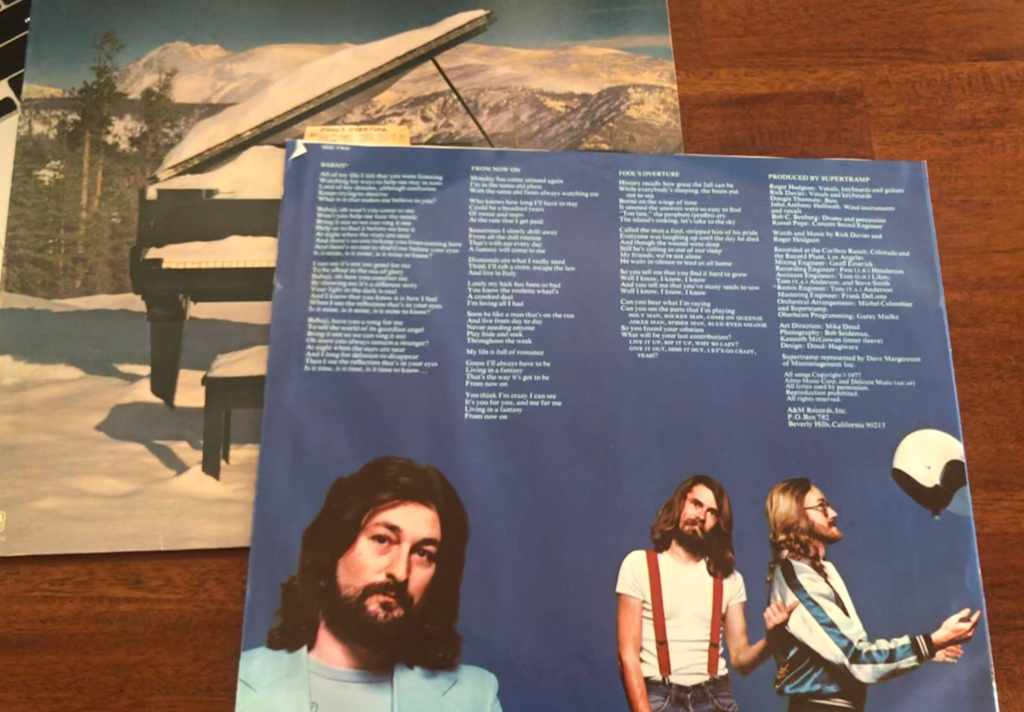
EVEN IN THE QUIETEST MOMENTS by Supertramp

I reached into my crates and pulled one of my uncle’s records out at random to revisit. Oddly enough, I pulled out Supertramp’s album EVEN IN THE QUIETEST MOMENTS, which was recorded in Nederland, Colorado, a town that’s not far from my home. I really like the album artwork, a photograph of a snow-covered piano. According to my vigorous online research, the photo was taken at a ski lodge in Boulder County, again not far from my home. Even stranger, the album was released 44 years ago this month! I guess it’s kismet.

After admiring that album cover, I flipped the sleeve over and checked out the tracklisting. My heart kind of sank. The only track I recognized was the first one, “Give A Little Bit.” I guess I should talk a little bit about my relationship with Supertramp: I don’t really have one. Sure, I love all the singles I grew up hearing on classic rock radio, but I’ve never sat down and given one of the band’s albums a listen. My favorite Supertramp song is probably “Bloody Well Right” off of CRIME OF THE CENTURY. Looking into the band’s discography, it seems that 1979’s BREAKFAST IN AMERICA (the album they released right after EVEN IN THE QUIETEST MOMENTS) is the band’s big album. I’ve heard over half of that album’s tracks on the radio over the years.

But I’m not here to talk about BREAKFAST IN AMERICA. I’m here to discuss EVEN IN THE QUIETEST MOMENTS. The album opens as I said, with “Give A Little Bit.” Even though I’ve heard this song hundreds of times, I was surprised at how great those crisp opening guitar chords sound. This is a great way to open a record, though this song feels a decade older than it is. Rather than being a song from the year Star Wars came out, this feels like a 1960’s summer of love song. The core message of the song is very hippy-dippy and runs counter to the slightly snarkier tone of the majority of Supertramp’s songs I’ve heard over the years.

The second track, “Lover Boy,” is a piano ballad with some nice guitar tossed in for good measure. The whole track is drizzled with some syrupy strings that belie the song’s subject: the titular “lover boy.” Apparently this lover boy has read a book on seduction and uses deception to entrap women. I love the jaunty piano riff; it really grows on you and is a nice contrast to the song’s dark themes. A little over halfway through the runtime, the song has a fake out ending and when the song resumes, it’s much darker and more guitar-driven. Usually, I don’t care for tricks like that, but I thought it worked well here.

The third track, “Even in the Quietest Moments,” opens with chirping birds and a clarinet, which is strange but not unwelcome. Soon, however, the track devolves into a mystical-acoustic ballad that sounds like a parody of something off of LED ZEPPELIN III. The lyrics are addressed to God seem to be about the distance between God and man. It’s competent, but I still found myself feeling a little embarrassed to be listening to it. “Downstream” is another piano ballad, and here I should point out that EVEN IN THE QUIETEST MOMENTS does not feature Supertramp’s trademark Wurlitzer electronic piano. The zany, high energy the Wurlitzer brings to many classic Supertramp singles (“Goodbye Stranger”) is entirely missing from this record. “Downstream” is a simple love song about…taking a boat ride on a Sunday? This straightforward song frankly feels like filler.

The next track,”Babaji”, reminds me very much of George Harrison’s solo track “My Sweet Lord.” The obvious reason is the references to Indian/Hindu spiritualism but also because both songs are about “being strangers” to God and yearning to be with a higher power. Apparently, yes, I had to look this up, “Babaji” is about Mahavatar Babaji, a religious figure Supertramp’s Roger Hodgson greatly admired. There’s probably a lot going on in this song that my ignorance on the subject matter obscures, but for the most part, I think this is a solid enough track. This was released as a b-side, and it feels like one.

EVEN IN THE QUIETEST MOMENTS finishes up with two really strange tracks. The bizarre piano ballad “From Now On” and the lengthy prog track “Fool’s Overture.” The former has the strangest/laughable lyrics on the album:

“Sometimes I slowly drift away

From all the dull routine

That’s with me every day

A fantasy will come to me

Diamonds are what I really need

Think I’ll rob a store, escape the law

And live in Italy”

I like the lyrical hook and the saxophone paired with it, but this track is goofy. There’s a vocal choir that comes in near the end, too, that is like crazy icing on a batshit cat. “From Now On” is so ballsy that by the end, it convinces me that it’s not insane but actually rather awesome. Well played, Supertramp. “Fool’s Overture” clocks in at 10 minutes and 53 seconds–which, can I say: what the heck, Supertramp? Why not find an extra seven seconds and push this thing to eleven minutes? “Fool’s Overture” is a mishmash of songs/song ideas that also features sound clips of Winston Churchill. According to Wikipedia, it took five years to write, which checks out as this thing is sprawling and probably blows you away when you’re high…but honestly, it felt a bit too generic for me. Yes, a song featuring weird woodwinds, Winston Churchill, and William Blake is generic. Whenever I hear stuff like this, I think about how intricate and challenging it was to create and how eager I am for it to be over. Prog is not my favorite genre by any stretch, so maybe I’m biased, but compared to some of the prog I’ve liked over the years (Gabriel era-Genesis), this doesn’t stack up as anything other than a couple of long songs stitched together.

Overall, EVEN IN THE QUIETEST MOMENTS reveals a more subdued version of Supertramp I was unfamiliar with. Clearly, the band’s non-singles output is worth checking out, though I get the impression from this album that it’s a bit spottier than I might have thought. Still, half of the songs work for me, and other than “Fool’s Overture,” even the misses on the record were interesting.

WHAT’S YOUR PLEASURE? by Jessie Ware

Lately, I’ve been making a conscious effort to listen to songs and albums outside of my go-to genres (rock, indie rock, classic rock, rock-rock). To that end, I devoured Jessie Ware’s 2020 electro-pop album WHAT’S YOUR PLEASURE? upon seeing it crop up on not one but two best of the year lists from critics I follow. A few people online described WHAT’S YOUR PLEASURE? as a “disco” record, which usually would have given me pause; however, I’ve recently discovered that much of the negative attitude towards disco music comes from the fact that disco’s stars were gay and black. I’m not saying everyone who burned disco records in the last 1970s was a homophobic racist, but that certainly factored into some folks thinking. Even if they weren’t 100% aware that this was a reason they “hate” disco. Anyway, that’s probably a post for another time–the bottom line is I felt that despite having grown up in a rock rules/disco drools household, I shouldn’t avoid an album because it’s “disco.”


And frankly, WHAT’S YOUR PLEASURE? is not a disco album. It’s electronic pop, and yeah, some of the grooves could be used to shake your booty, but I would not call this a “disco” record for the most part. It is very much a throwback album that mixes the disco music of the 1970s with 1980’s electronic/New Wave. I’d never heard of Jessie Ware, so I assumed she was a throwback artist who has been churning out this kind of retro dance music for a while, but upon looking into it, I found that Jessie Ware’s career has been spent crafting perfectly fine, adult-oriented, pop music. I browsed her top tracks on Spotify and none of them not from WHAT’S YOUR PLEASURE? dip into this chirpy, synthed out sound.


I was around in the ’80s, but I was a kid and spent most of that time listening to the music from the ’60s and ’70s my parents grew up listening to, so my frame of reference here is a bit off. What I’m trying to say is that I only have a vague notion of the artists Jessie is referencing in these songs. “Ooh La La” sounds like a Tom Tom Club song, but that’s probably because I only recently discovered the Tom Tom Club. I recently chatted with my friend Lisa Peers about this record, and she pointed out that the album’s final track, “Remember Where You Are,” bears more than a passing resemblance to a track by The 5th Dimension, “Up, Up and Away.” This was not a song (or band) that I’d encountered before, but upon listening to “Up, Up and Away” I totally hear it. All of this is to say that WHAT’S YOUR PLEASURE? fascinates me but might bore someone who’s been there and done that when it comes to these genres.


Thematically, WHAT’S YOUR PLEASURE? is all about being in love and wanting to be with the one (boy) you love. The album opens with “Spotlight” which is about the yearning of being with a lover and not wanting a night to end. “Save a Kiss” and “Adore You” similarly address a lover and are about the desire to be with another person. This primal hunger for love emanates over the record; however, the record careens into darkness as the song’s cuteness gives away to a bit of manic obsession. “Adore You” features a creepy, pulsing beat and the hauntingly repetitive lyrics “I adore you.” Ware’s voice is dipped in a robotic vocal effect that freaked me the fuck out. Sure, we all want to be adored, I guess, but it starts to feel a bit, too much. On “What’s Your Pleasure?” Jessie’s voice alternates between angelically cooing and sexily breathy. This is a woman I want to spend time with. But on “Adore You” she’s essentially chanting “I adore you” and “don’t go.” This is a woman I would be afraid of and would worry that she would kill my daughter’s pet rabbit.


However, this tonal shifting works in the album’s favor because it allows Jessie to really show off her voice. She’s able to take somewhat creepy lyrics and make them sound pleasant (and vice versa). The hooks, for the most part, are fantastic–these are catchy songs. The only exception being “Adore You” which is just her droning “I adore you.” Besides the simplistic nature of that track, my only real complaint about the album is that I think it should have ended with “The Kill.” This track feels like the culmination of the album, wherein the darkness that’s been lurking in the background finally comes to the foreground with Jessie singing, “Don’t kill me with your love.” Instead of letting this dark end cap off the album, WHAT’S YOUR PLEASURE? ends with the previously mentioned “Remember Where You Are” which sonically veers away from the predominately dark 80’s synths towards the shinny 70’s pop. I considered suggesting this track open the album, which would have sort of worked, but honestly, the track stands out like a sore thumb because it doesn’t stick to the album’s themes of love, yearning, and obsession.


This is an excellent record and gets better each time I sit down and listen to it. I know I love an album when my favorite track keeps shifting, which totally happened with WHAT’S YOUR PLEASURE? Jessie Ware was not on my radar, but I’m going to follow her career. I’m particularly interested in seeing where she goes from here. I think it would be interesting if she continued to explore more retro sounds, but I’m not sure how long this could be done without getting stale. Give WHAT’S YOUR PLEASURE? a spin and let me know what you think.

ANAK KO by Jay Som

Feeling the crushing weight of impending fatherhood, I sought refuge in the calming musical shores of dream-pop/shoegaze back in 2015. The genre quickly became something of a security blanket for me, which is probably why I dusted off my shoegaze playlist again in mid-2020. Seeking to add new tracks to my shoegaze playlist, I stumbled upon Jay Som’s “Superbike,” which led me to her 2019 album ANAK KO, a record that has become one of my top pandemic albums.

Jay Som is the stage name for California singer-songwriter Melina Mae Duterte who came to the world’s attention in 2016 with her bedroom record, TURN INTO. That self-recorded album launched her career as both an artist and producer. ANAK KO was also recorded and mixed by Duterte but unlike her previous album also features her touring musicians on guitar and drums. I mention this because I’m going to gush about how good this sounds for a so-called bedroom album. And while the record was put together outside of a traditional recording environment, I want to acknowledge that ANKAK KO isn’t just Duterte sitting alone in her room. Although, from what I can tell, much of this might have been recorded in her bedroom. Why does any of this matter? Because ANAK KO is a lush, at times achingly beautiful album; it’s not a D.I.Y. record. This is not a static-laced lo-fi record. ANAK KO is so polished that even if the songwriting weren’t as good, I’d still be impressed.

But the songwriting is really good. The album is ostensibly classic dream-pop, with Duterte’s soft, almost whispered vocals riding a crest of shimmering sonic soundscapes. Lyrically, ANAK KO is like standing over someone’s shoulder and reading their diary; the songs (even the sunnier-sounds ones) are full of the neurotic yearnings and anxiety of a young person. Like most good art, there’s a failed relationship casting a terrible shadow over ANAK KO. This shadow is the glaze on the album’s doughnut, taking good songs and making them fantastic. The creeping drone found part of the way through “Peace Out” is the best, and my favorite, example. Even on tracks that ostensibly sound happy/upbeat, there’s a beating heart of darkness.

Yes, there are lots of ’80s tinged keyboards indicative of dream-pop, but Duterte has all kinds of tricks up her sleeve. She packs the album with all kinds of neat little production embellishments that allow ANAK KO to escape easy classification. There’s a dollop of country guitar on the album closer “Get Well.” The song “Peace Out” sounds like an early Best Coast track. There’s a violin part on “Nighttime Drive” that oddly reminded me of “Blimps Go 90” by Guided by Voices. The quick staccato of guitar chords and hypnotic melody on “Superbike” reeled me in, but it was all these little details sprinkled throughout ANAK KO’s production that kept me coming back.

I’ve seen this album described as a headphones record in reviews, but for me, that’s a bit limiting and undersells the production. Like I stated earlier, ANAK KO is a lush record. It’s painfully personal and brimming with nostalgic flourishes whose sincerity helps it avoid being just another gimmicky throwback. I really cannot overstate how good this album is and eagerly I await Duterte’s next project.

HYPNOTIC EYE by Tom Petty and the Heartbreakers

I forget that Tom Petty is dead. Growing up, Petty’s music was all over FM radio, and his videos were in regular rotation on MTV. His music reminds me of late-night car rides down winding backroads and frigid early morning commutes in my dad’s Chevy. I saw Petty live in concert in 1995 and then pretty much quit following his career. The last Petty album I’d bought and listened to was 1999’s ECHO. I remember thinking it was decent for a legacy act. Yes, in 1999, I had written Tom Petty off. And the rest of the world seemed to as well. I didn’t see Petty on TV, and the radio only played the same seven or so hits.

When HYPNOTIC EYE came out, I noticed that it was mainly getting positive reviews, but I was wrapped up in a cross-country move and finding a new job. Then, in January of this year, I scheduled a video chat with my friend and fellow music blogger, Lisa Peers.* Rather than sort of stutter our way through yet another awkward Zoom call, I proposed that we pick an album to discuss. Knowing that Lisa is a huge Tom Petty fan, I let her choose one of his late-period albums. Happily, she chose 2014’s HYPNOTIC EYE.

All I knew before listening to HYPNOTIC EYE was that it was the final Tom Petty and the Heartbreaker album and that critics at the time had hailed it as a “return to form.” My first listen was underwhelming. The songs all seem to fall into the same mid-tempo, and the song hooks weren’t hitting. Had I not needed to digest this record to discuss it with a super-friend properly, I likely would have just written it off. And that would have been a shame because HYPNOTIC EYE is an excellent record.

The chugging “American Dream Plan B” opens the album. It’s a harder, more raw song than I was expecting. There’s a weird vocal effect on Petty’s voice for some of the song, and initially, I was worried this was going to be crutch found all over the album, but this fear proved unfounded. Petty sounds fantastic on HYPNOTIC EYE. Though there isn’t a theme, per se, HYPNOTIC EYE does seem like a meditation on getting older. On “American Dream Plan B” Petty voices his bemusement at his staggering success, while on “Fault Lines” and “Sins of My Youth,” he addresses his failings. This isn’t groundbreaking stuff for a rockers’ late-period album, but Petty puts a nice spin on all these cliches. I like the comparison of a fault line and a personal flaw/fault. The bluesy ditty “Full Grown Boy” features lyrics about both being a “full-grown boy” but a full-grown “changing every day.” And I think that might be the key to understanding why HYPNOTIC EYE turned out to be such a good record–Petty never quit evolving both as an artist and as a man.

I love “Red River,” a witchy-woman track that would fit nicely on FULL MOON FEVER. Likewise, the album closer, “Shadow People,” feels like a song I’ve grown up hearing my whole life. Even in 2014, Petty was still minting classics. I’m also delighted that the final Heartbreakers album has a pot reference (“U Get Me High”). It would have been a shame if Petty’s last dance with the Heartbreakers hadn’t also included Mary Jane. Really, there’s only one dud on the whole album, “Burnt Out Town.” This, the second to last track is basically a parody of blues music with painfully obvious rhyming lyrics. When I chatted with Lisa, I had her guess which track I liked the least; she could easily guess this one. It’s a bad track. Luckily, the album doesn’t close with it, so Tom Petty and the Heartbreakers get to ride off into the sunset on a winner.

Listening to HYPNOTIC EYE in 2021 made miss Tom Petty. After the first few listens, when the songs started to click with me, I couldn’t help but think, “Man, this is great, I can’t wait to hear the next album…” Guys like Tom Petty are so good for so long we take them for granted. I hate that I slept on this record for so long, don’t make the same mistake.

*Lisa is also a novelist

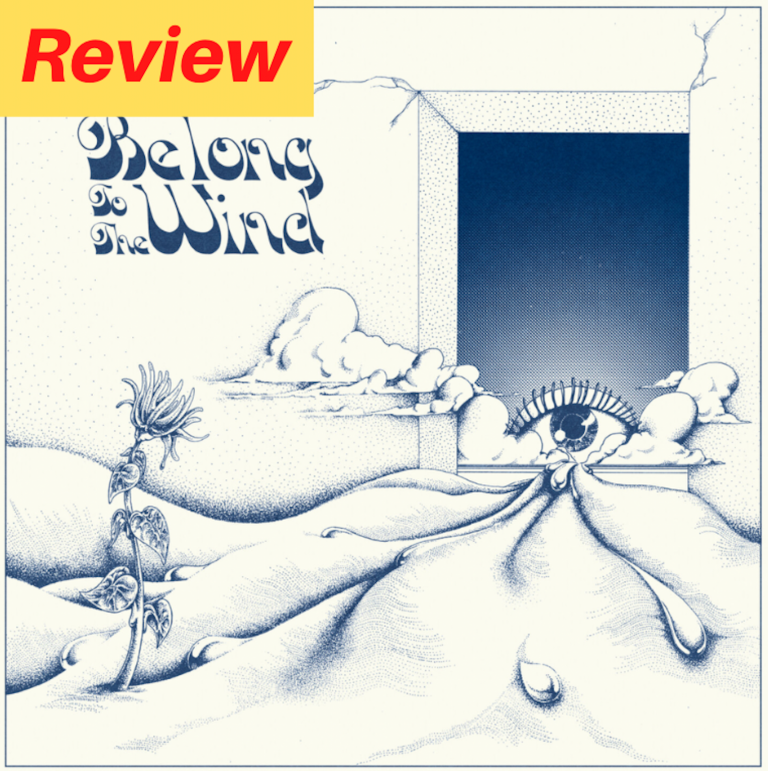
BELONG TO THE WIND by Various Artists

I graduated from High School and classic rock radio around the same time. I got a job in a bookstore, and on my lunch breaks, I would pour over the shorter more obscure album reviews in the back of Mojo and Spin. Thus my journey into indie rock began and for a time, I left the mainstream behind. It blew my mind that so many outstanding artists could be so under-appreciated. As I got older and I watched the majority of these indie bands fade into obscurity, I realized that this was not a new phenomenon. The stuff on the radio is…well, the stuff on the radio. But the more interesting stuff was probably languishing in obscurity.

So I’m really into lost bands and dusty 45s from artists who never made it big, despite having a lot to say. With the resurgence in vinyl records, a curious (and frankly awesome) subculture of music nerds has started boutique labels with the sole mission of panning for this rare musical gold and reissuing it. One such label, Forager Records out of sunny California, has just released its debut album BELONG TO THE WIND. According to their website, the label scrounged many dusty 45s to unearth this “mellow drift through psychedelic folk & soul gathered from American 45s of the 1970s.”

Needless to say, with a description like that I pulled out my credit card and ordered a copy of the record. This compilation did not disappoint. An eclectic mix of tracks that all share a common thread of loneliness and introspection BELONG TO THE WIND beautifully illustrates my theory that much of the best music did not make the Billboard Top 100 and is languishing in obscurity. The collection opens with the shimmering “Spend Another Day” by Autumn Dust. This track perfectly sets the mood for the rest of the record. There’s a painful longing in the singer’s voice. Who is he? I have no idea. A Google search for Autumn Dust reveals nothing. And so it goes for all the other artists featured. The mystery behind who these people are only serves to heighten the aura of mystery surrounding the track.

Despite the label touting “psychedelic folk & soul,” none of the tracks falls neatly into any one genre. And none of them fall into the trap of boring ’70s singer-songwriter cliche. The second track, “Oh Man” by Cisco, features an oddly haunting saxophone. Most of these tracks are downers, just a glance at the titles will tell you that: “I’ll Never Be the Same” and “Time for Us to Part” being the most obvious. But even songs with even less somber titles still go hard on the sorrow. A good example is the track “I Want to Change My Life,” whose soulful lyrics seem to be a helpless cry for change that might not be possible.

The record’s standout track is the devastating “Anticipation of the Sun” by Jeff Laign. The song, ostensibly about the death of a best friend, is sung with aching sincerity and with a voice that always seems on the verge of breaking. The spooky, almost lo-fi production left me feeling haunted every time I pushed play. Who the hell was/is Jeff Laign and why didn’t he become a household name? “Anticipation of the Sun” is worth 50 Cat Stevens songs; why didn’t he become more famous?

If I have any gripes with BELONG TO THE WIND, besides its brevity (the ten tracks clock in at just 40 minutes), it’s that only one song has a female singer. And what a song it is, too–“The Lady Has No Heart” by a band called St. Elmo’s Fire feels like a forgotten Fleetwood Mac b-side. I could have used just a little bit more of that, but otherwise, this is a perfect collection of lost classics ideal for lonely Sunday afternoons. Hopefully, Forager Records will make enough money off BELONG TO THE WIND to release more forgotten music.

If you’re interested in buying a copy of the record or just want to listen to these songs, visit the Forager Records website.